Blog

  • 7 Agency Rank Tracking Features That Save Reporting Time

    7 Agency Rank Tracking Features That Save Reporting Time

    Quick Summary: Agency reporting is slow because of manual tasks like building reports and formatting data. Features like automated scheduled reports, white-label templates, multi-client dashboards, and client portals can significantly cut this time. The best tools automate data collection, branding, and sharing, helping teams manage more keywords and locations efficiently. SnowSEO offers these features to streamline agency SEO reporting workflows.

    Agency reporting slows down when rank data still sits in spreadsheets, screenshots, and weekly slide decks. Teams may track daily, but they still waste hours turning movement into client-ready updates across many accounts, locations, and stakeholders. This list ranks the Rank Tracking Features that cut the most labor. We chose these Rank Tracking Features by one test: Reporting Time Saving. The best Agency SEO Tools use Rank Tracking Features that automate collection, speed delivery, reduce screenshot work, shorten analysis, and need little cleanup.

    Quick Comparison

    Feature Best for Reporting time saved Agency value Coverage
    Automated scheduled reports Agencies that send recurring client updates High Eliminates repetitive report assembly Weekly, monthly, and custom schedules
    White-label reporting Client-facing agencies and consultants High Speeds up branded deliverables Reports, dashboards, and portals
    Multi-client dashboards Agencies managing several clients High Centralizes performance review Portfolio and project-level views
    Client portal or guest access Agencies with hands-on clients Medium to high Reduces repetitive client questions Read-only or limited-access views

    What to know about rank tracking features

    Agencies do not save time from prettier charts. They save time from features that remove repeat work. That can mean pulling data faster, cutting report formatting, or giving clients a clear reason for ranking changes.

    That matters more in 2026 because teams manage more keywords, more locations, and more client updates with the same headcount. The best rank tracking features keep reports accurate, branded, and easy to share without adding manual cleanup.

    Judge each feature by one thing: how many reporting steps it removes.

    1. Automated scheduled reports

    This is the biggest time-saver in rank tracking. Automated SEO reporting cuts the repeat work of building the same update every week or month, while tools pull core metrics like clicks, impressions, CTR, and position from Search Console performance reports.

    Agency strategist scheduling recurring SEO reports on multiple screens
    Agency strategist scheduling recurring SEO reports on multiple screens

    Highlights

    • Cuts screenshot and copy-paste work
    • Keeps every client on a fixed cadence
    • Lowers the risk of missed updates

    Specs

    • Best for: Agencies sending recurring client updates
    • Reporting time saved: High
    • Coverage: Weekly, monthly, custom schedules

    Pros

    • Scales across many accounts

    Cons

    • Needs setup first

    It ranks first because Google supports report exports and sharing, but scheduling replaces the repeated human task.

    Last updated: July 21, 2026

    Also Read: 10 New Keyword Research Techniques to Try Now

    2. White-label reporting

    White-label reporting makes rank updates look like they came from your agency, not a third-party tool. It cuts the extra slide work because branded dashboards, logos, and custom domains are built in, as shown by SE Ranking’s white-label setup and Mangools’ branded report options.

    Highlights

    • Adds agency branding without extra design work
    • Creates a polished client experience
    • Helps reports double as retention assets

    Specs

    • Best for: Client-facing agencies and consultants
    • Reporting time saved: High
    • Agency value: Speeds up branded deliverables
    • Coverage: Reports, dashboards, and portals

    Pros

    • Improves perceived professionalism
    • Avoids duplicate formatting in external tools
    • Works well for multi-client deliverables

    Cons

    • May be tied to higher-tier plans
    • Setup can take time upfront

    It ranks high because it turns raw rank data into client-ready output fast.

    Last updated: July 21, 2026

    Also Read: Best SEO Tools: 25 Picks to Improve Rankings in 2026

    3. Multi-client dashboards

    Track all client rankings from one place. Multi-client SEO dashboards cut reporting time because your team reviews trends, visibility, and account health in one workspace, not ten tabs. Google Search Console supports multiple properties, and its Performance report shows clicks, impressions, CTR, and position for faster checks.

    Account manager reviewing client ranking dashboards on dual monitors
    Highlights

    • Combines client, portfolio, and project views
    • Speeds up cross-account comparisons
    • Cuts login switching and repeat analysis

    Specs

    • Best for: Agencies managing several clients
    • Reporting time saved: High

    Pros

    • Faster monthly prep
    • Easier trend spotting

    Cons

    • Can get cluttered without clear naming
    • Larger teams may need training

    It ranks here because less context switching means faster reporting prep.

    Last updated: July 21, 2026

    Also Read: 10 Best Tools for Competitor SEO Analysis in 2024

    4. Client portal or guest access

    Client portals cut status emails fast. Clients can check ranks, clicks, and average position on their own, and Google notes those metrics in Search Console performance reporting. That means fewer export requests and less ad hoc explaining in your client reporting automation flow.

    Highlights

    • Reduces request-driven reporting
    • Gives clients on-demand visibility
    • Lets agencies control what data is shared

    Specs

    • Best for: Agencies with hands-on clients
    • Reporting time saved: Medium to high
    • Agency value: Reduces repetitive client questions
    • Coverage: Read-only or limited-access views

    Pros

    • Cuts routine reporting requests
    • Improves transparency
    • Useful for account management workflows

    Cons

    • Clients still need onboarding
    • Access control must be managed carefully, since shared views only allow limited actions in Search Console report sharing

    It ranks high because it cuts communication overhead, not just report-building time.

    Last updated: July 21, 2026

    More Time-Saving Features Worth Noting

    A few features missed the main list but still cut busywork fast. These matter most when your agency reports by location, reacts to sudden drops, or pipes data into other systems.

    • 5. Local and grid rank tracking – Essential for agencies that report by city, zone, or store location.
    • 6. Alerting and change notifications – Catch ranking drops before they become reporting surprises.
    • 7. Scheduled exports and API access – Best for teams that want rank data pushed into their own workflows.

    How to choose the right rank tracking feature

    Pick based on your biggest reporting bottleneck, not the longest feature list.

    • Choose scheduled reports first if your team rebuilds the same monthly deck. This saves the most time fastest.
    • Pick white-label reporting if clients want polished deliverables without extra screenshot cleanup. SnowSEO stands out here for agencies that want one cleaner workflow.
    • Use multi-client dashboards if account switching slows reviews and portfolio updates.
    • Add client portals or guest access if status-check emails eat your day.
    • Choose local or grid tracking for location-based clients.
    • Add alerts and API exports last once your core reporting flow already works.
    Homepage
    Homepage

    Cut reporting time and keep rankings, audits, and content work in one place with SnowSEO. Start there if your team needs faster, cleaner client reporting.

    Frequently Asked Questions

    Q1: What are the most impactful features in agency rank tracking tools that save reporting time?

    Scheduled reports, white-label templates, keyword tagging, location-level tracking, and client-ready dashboards save the most time. They cut copy-paste work, speed QA, and help account managers pull the right view fast.

    Q2: How does white-label reporting accelerate SEO reporting workflows for agencies?

    White-label reporting removes design rework on every client update. You set one branded template, auto-fill ranking data, and send cleaner reports faster. It also reduces mistakes when multiple team members handle reporting.

    Q3: What local SEO features are essential in agency rank tracking tools for multi-location clients?

    Look for zip code or city tracking, map pack visibility, device splits, location tags, and grouped reporting by branch. These features help you spot weak locations fast and show each client site’s local search impact clearly.

  • In-Depth Comparison: SnowSEO and AthenaHQ for Enterprise SEO

    In-Depth Comparison: SnowSEO and AthenaHQ for Enterprise SEO

    Quick Summary: AthenaHQ is best if your main focus is tracking brand mentions across AI platforms and measuring visibility, especially for large enterprises. SnowSEO offers a broader SEO workflow, combining monitoring with audits, content creation, and ranking, making it ideal for teams that want to act on data within one system. Choose AthenaHQ for AI mention insights and SnowSEO for comprehensive SEO management.

    Enterprise teams now need more than rank tracking. They need a fast system to catch brand mentions across ChatGPT, Perplexity, Claude, Gemini, and AI Overviews, then tie that data to action. This review tackles that gap. It compares SnowSEO and AthenaHQ on visibility, attribution, reporting, and response speed. I focus on real buying questions teams ask when weighing AI SEO Platforms, SEO Automation Tools, and practical Enterprise SEO Strategies for large sites and brands.

    How AthenaHQ and SnowSEO Handle AI Brand Mention Monitoring

    AthenaHQ leans into a cross-model tracking view. It is built to see whether your brand appears, how it is framed, and which sources support that mention across tools like ChatGPT and Claude. That matters because AI visibility is fragmented by platform, and only a small set of brands stay visible everywhere, according to Semrush’s 2026 AI Visibility Index coverage. For teams running Enterprise SEO Strategies, AthenaHQ fits best when brand mention share is the main KPI.

    SnowSEO takes a wider workflow approach. It can support AI visibility checks, but it also ties them to audits, keyword work, content production, and competitor tracking. That makes it more useful when your team wants action after the mention data, not just monitoring.

    If your workflow starts with “Where are we mentioned?”, AthenaHQ feels tighter. If it starts with “How do we improve visibility next?”, SnowSEO fits better.

    Also Read: Comfy UI vs SnowSEO Dashboard: An Honest Comparison for SEOs

    Which Platform Fits Enterprise SEO Strategies Better?

    AthenaHQ fits best when your main need is AI visibility oversight. If leadership asks, “Where is our brand showing up in AI answers, and how do we respond fast?” AthenaHQ is the cleaner pick. That matters more now because Google says AI search still runs on core ranking systems, while brands also need to watch how they are mentioned across the web in AI-driven experiences according to Google.

    SnowSEO fits best when your team needs an operational system, not just monitoring. If you want audits, keyword research, content support, rank tracking, and competitive workflows in one place, SnowSEO is the stronger fit. Adobe notes that enterprise teams now need more than rankings alone, including citation visibility, governance, and measurable action across AI and search surfaces in this 2026 overview.

    Pick AthenaHQ for focused AI mention tracking. Pick SnowSEO if enterprise SEO work must move from insight to execution inside one stack.

    Pros and Cons of AthenaHQ vs SnowSEO

    What stands out

    • AthenaHQ stands out for AI visibility depth. Its site highlights tracking across 8+ LLMs, brand mentions, sentiment, and board-ready reporting AthenaHQ’s platform overview.
    • SnowSEO stands out for breadth. It combines classic SEO, GEO, content creation, and wider CMS publishing in one workflow, based on SnowSEO’s Athena comparison.

    Where each platform falls short

    • AthenaHQ can feel pricey and usage-based, so costs may rise with heavier tracking.
    • SnowSEO is the better all-in-one pick, but teams that want very deep enterprise AI reporting may still prefer AthenaHQ’s narrower focus.

    Also Read: Best SEO Tools: 25 Picks to Improve Rankings in 2026

    Which One Should You Choose?

    Choose AthenaHQ if your main goal is AI mention monitoring. It is a better fit when you need to track share of voice, citations, and brand visibility across AI answers. AthenaHQ’s own 2026 report says new GEO metrics now matter, like mentions per prompt and daily citations in AI search State of AI Search 2026.

    Choose SnowSEO if you need a broader SEO execution stack. SnowSEO fits teams that want audits, keyword research, content generation, rank tracking, and AI visibility work in one place. That matters because many GEO tools still split monitoring from action, as noted in this 2026 GEO tools comparison.

    Pick AthenaHQ for reporting-first AI visibility. Pick SnowSEO for doing the work too.

    Homepage
    Homepage

    Need broader SEO automation plus AI visibility tracking? Try SnowSEO to audit, create, track, and act faster across search and AI platforms.

    Frequently Asked Questions

    Q1: How does AthenaHQ monitor AI platforms like ChatGPT and Perplexity for brand mentions?

    AthenaHQ tracks prompts, checks brand mention presence, and shows how AI engines describe your brand, rivals, and topics over time.

    Q2: What are the key differences between SnowSEO and AthenaHQ for enterprise SEO?

    SnowSEO covers broader SEO work, while AthenaHQ stays more focused on AI mention monitoring, reporting, and visibility tracking.

    Q3: Is AthenaHQ’s pricing suitable for mid-sized agencies or only large enterprises?

    AthenaHQ tends to fit larger teams better, while smaller agencies may want broader value and workflow coverage before committing.

    Conclusion

    AthenaHQ fits teams that need tight AI mention tracking and governance. SnowSEO fits broader SEO automation. Since AI visibility varies by platform and brand maturity, cross-platform measurement matters, and integrated reporting is now a real gap.

  • Surfer SEO Partners with SnowSEO for Enhanced On-Page Analysis

    Surfer SEO Partners with SnowSEO for Enhanced On-Page Analysis

    Quick Summary: The partnership between Surfer SEO and SnowSEO streamlines on-page SEO by integrating Surfer’s content guidance with SnowSEO’s workflow tools. This combo allows teams to quickly identify issues, create briefs, optimize content, and track results all in one system. It helps agencies and small businesses improve efficiency without adding staff, especially as SEO shifts toward AI-driven search standards.

    Surfer SEO’s 2026 updates lean hard into AI search rules, Content Editor automation, and citation signals. SnowSEO brings keyword clustering, automation, and AI-platform visibility. That makes this partnership useful for faster On Page Optimization. Teams now need On Page Optimization that fits Google and AI search, without messy tool stacks. This article looks at how stronger On Page Optimization, sharper SEO Content Strategy, and better Keyword Research Tools can work together across multi-page content workflows.

    What the partnership changes for on-page analysis

    Why the workflow matters now

    On-page analysis is no longer just a page score check. Surfer’s 2026 updates push teams to connect ranking signals with AI citation signals in one loop. Surfer says its newer workflow links AI Tracker, Content Editor, and Auto-Optimize so teams can move from finding weak pages to fixing them faster in the same flow, as shown in Surfer’s March 2026 update. That matters for agencies and content teams with lots of pages, because less tab switching means fewer missed fixes and quicker refresh cycles.

    Flowchart illustrating streamlined on-page SEO workflow
    Flowchart illustrating streamlined on-page SEO workflow

    Where SnowSEO adds value

    SnowSEO fits this shift by giving teams a second layer of action. If Surfer sharpens page-level guidance, SnowSEO can help turn that insight into broader content ops across audits, keyword planning, and AI visibility work. The practical gain is a tighter handoff: analyze in Surfer, then use SnowSEO to scale fixes across clusters and keep reporting in one place. Surfer’s own 2026 workflow update shows teams now need monitoring, quick wins, and content refreshes in one system, not scattered tools across the workflow.

    Also Read: Best SEO Tools: 25 Picks to Improve Rankings in 2026

    How Surfer and SnowSEO complement each other in practice

    Surfer handles page-level guidance well. SnowSEO helps teams cover the wider workflow. That mix works best when you want tighter on-page edits without losing keyword planning, publishing, and cross-channel tracking. For the full partnership context, link this section back to the main pillar post.

    From keyword research to page brief

    Start in SnowSEO to find topic clusters, gaps, and target pages. Then move the chosen keyword into Surfer’s Content Editor, where the 2026 wizard pulls in SERP context, templates, and brand inputs before drafting, according to Surfer’s March 2026 update.

    • SnowSEO picks the opportunity
    • Surfer shapes the page brief
    • Writers get clearer targets faster
    Content editor workspace with workflow diagram and digital tools
    Content editor workspace with workflow diagram and digital tools

    From draft to optimization

    Once the draft exists, Surfer becomes the fast editing layer. Its AI Search Guidelines and Auto-Optimize help add missing facts, entities, and structure for stronger on-page coverage, based on Surfer’s January 2026 feature update.

    Use SnowSEO for content production scale, then use Surfer for final on-page tightening.

    1. Draft in SnowSEO
    2. Refine in Surfer
    3. Review voice and claims manually

    From optimization to reporting

    After publish, SnowSEO can keep tracking rankings, AI visibility, and broader performance in one place. Surfer then helps with refresh work when a page slips or misses citation value.

    Stage Surfer role SnowSEO role
    Planning Brief guidance Keyword and cluster research
    Editing On-page recommendations Draft creation and publishing
    Tracking Refresh signals Rank and AI visibility reporting

    This setup fits agencies that want fewer handoffs between strategy, writing, and reporting.

    Why agencies and SMBs should care

    Agencies should care because faster on-page review means more output without adding headcount. That matters when many firms still feel margin pressure, and over half now see AI as a real threat to the agency model, according to SparkToro’s 2025 agency survey.

    For in-house teams and SMBs, the value is simpler: less tool hopping and quicker fixes. Small firms using AI already apply it to marketing and content, and 98% say it has not cut headcount, based on CNBC’s NFIB survey coverage.

    If this partnership reduces review time, lean teams get enterprise-like help without enterprise overhead.

    How this partnership fits the broader 2026 SEO stack

    The takeaway for optimization teams

    For 2026 teams, this partnership fits the shift from rank tracking to workflow-led search visibility. Search Engine Land says the SEO stack now blends classic SEO, AI influence, and tighter quality standards across content ops in its 2026 outlook. Ahrefs also notes AI Overviews cut clicks and push teams to cover topic depth, not just single terms in its 2026 trends report. For SnowSEO users, that makes Surfer-style on-page guidance more useful inside one operating system.

    Homepage
    Homepage

    Want faster on-page fixes after the Surfer SEO partnership news? Try SnowSEO to audit pages, build content, and track gains in one workflow.

    Frequently Asked Questions

    Q1: How does SnowSEO’s partnership with Surfer SEO enhance on-page analysis capabilities?

    It combines Surfer’s page-level content signals with SnowSEO’s wider workflow tools. Teams can spot gaps faster, tighten briefs, and move from audit to action in one setup instead of jumping between disconnected steps.

    Q2: What are the key features of SnowSEO’s integrated platform for SEO and AI content optimization?

    SnowSEO brings audits, keyword research, content generation, rank tracking, competitor checks, and AI visibility tracking into one platform. That helps teams manage both search rankings and AI answer presence without patching together several separate tools.

    Q3: How can businesses use SnowSEO to track AI platform mentions like ChatGPT and Claude?

    Teams can monitor whether their brand, products, and pages appear in AI-generated answers, then compare trends over time. That makes it easier to spot missing topics, weak authority signals, and pages that need clearer entity coverage.

    Conclusion

    Surfer and SnowSEO matter because they cut workflow friction. Surfer’s 2026 updates show tighter links between tracking and editing inside Content Editor, while SnowSEO strengthens practical on-page analysis for faster team action.

  • Comfy UI vs SnowSEO Dashboard: An Honest Comparison for SEOs

    Comfy UI vs SnowSEO Dashboard: An Honest Comparison for SEOs

    Quick Summary: Most SEO teams should pick SnowSEO Dashboard because it offers built-in rank tracking, AI mentions, and content results, making it easy to set up and use. ComfyUI is more suited for technical users who want to build custom AI workflows, not for day-to-day SEO tasks. If your focus is on search visibility and quick results, SnowSEO is the practical choice.

    Most SEO teams should pick SnowSEO Dashboard. It tracks rankings, AI mentions, and content results. ComfyUI fits a different job. It helps you build custom AI workflows. If you are choosing between AI flexibility and SEO visibility, this comparison shows where each tool fits for tracking, planning, and publishing based on real SEO use cases.

    ComfyUI vs SnowSEO Dashboard at a Glance

    ComfyUI SnowSEO Dashboard
    Primary purpose Visual AI workflow engine SEO and AI visibility dashboard
    Setup effort High Low
    SEO visibility tracking None Built in
    Automation depth Very high, but custom-built High, preconfigured for SEO
    Best for Technical AI workflow builders SEO teams and marketers

    How ComfyUI and SnowSEO Dashboard Compare

    ComfyUI

    ComfyUI is an open-source, node-based AI workflow tool for building custom image and model pipelines. It fits technical users who want deep control, not SEO teams that need ready-made search visibility data.
    ComfyUI
    Key strengths

    • Very deep automation
    • Flexible custom workflows

    SnowSEO Dashboard

    SnowSEO Dashboard is a unified platform for SEO and AI visibility tracking, content work, and brand mention monitoring. It fits marketing teams that want fast setup and built-in workflows instead of building systems from scratch.
    SnowSEO Dashboard
    Key strengths

    • Built-in SEO visibility tracking
    • High automation with low setup

    Use Case Fit for SEO Workflows

    ComfyUI is a node-based, open source workflow tool built for image and media generation, not day-to-day SEO ops, as noted by Wikipedia’s overview of ComfyUI. That matters fast.

    When a flexible AI engine is too much for SEO

    If your team needs keyword tracking, content briefs, audits, and reporting, a visual node graph is often extra work. You get freedom, but you also get setup overhead, testing time, and more room for workflow sprawl.

    • Good for custom AI experiments
    • Weak fit for repeatable SEO tasks
    • Harder for writers and account teams to adopt

    If the tool needs a power user to keep it useful, most marketing teams will not stick with it.

    Workflow comparison with node graph and dashboards
    Workflow comparison with node graph and dashboards

    Why SnowSEO matches marketing workflows

    SnowSEO fits better when the goal is search and AI visibility, not custom media pipelines. SEO teams usually need one place for:

    • audits
    • keyword research
    • content creation
    • rank tracking

    Comfy itself says it gives control over models, parameters, and outputs for visual AI work on its official site. That is powerful, but it is not the same as an SEO system built for marketers.

    Also Read: Best SEO Tools: 25 Picks to Improve Rankings in 2026

    AI Visibility, Rank Tracking, and Reporting

    Native metrics beat custom outputs here. Google says AI Overviews are a core Search feature, and they now reach users across many countries and languages, so teams need reporting built for real SERP behavior, not stitched-together logs from a workflow tool like ComfyUI according to Google Search Help. Track what matters:

    • AI Overview presence
    • brand mentions
    • source citations
    • click and rank shifts

    If the metric does not map to a search result, it is hard to trust in a client report.

    SnowSEO adds the missing layer for SEO teams. You get competitive monitoring, share-of-voice views, and reporting tied to search and AI visibility. That matters because AI Overviews can change brand discovery fast. A Medill study found AI Overviews appeared on 43% of tested queries, with much higher rates on informational searches in this research. Use a simple check:

    1. Track priority queries
    2. Watch competitor citations
    3. Report wins and losses weekly

    Which Should You Choose for Your Team?

    1. Choose SnowSEO if you need results fast
      SnowSEO fits SEO teams that want one place for audits, keyword work, content, tracking, and AI visibility. Pick it if marketers need clear workflows, fast setup, and reports without building systems first. It is the practical choice when your goal is traffic growth, not custom AI pipeline design.
    Marketing team comparing SEO dashboards on office wall screen
    Marketing team comparing SEO dashboards on office wall screen
    1. Choose ComfyUI only if workflow control is the priority
      ComfyUI makes sense for technical teams that need deep control over image and model workflows. It is a node-based tool, not an SEO platform, as shown by Wikipedia’s overview. Even Comfy’s site frames it around control over models and outputs, not search growth on its product page.

    For most SEO teams, this is an easy call: choose the platform built for SEO work.

    Homepage
    Homepage

    Pick the SEO-first option. Try SnowSEO to audit, track, and grow search plus AI visibility faster.

    Frequently Asked Questions

    Q1: What are the main differences between ComfyUI and SnowSEO Dashboard for SEO professionals?

    ComfyUI is a node-based AI workflow tool for building custom generation pipelines. SnowSEO Dashboard is built for SEO teams, with rank tracking, audits, keyword work, and AI visibility data in one place.

    Q2: How does SnowSEO’s AI-driven rank tracking compare to ComfyUI’s local node control capabilities?

    SnowSEO tracks search and AI visibility over time, so teams can spot gains and losses fast. ComfyUI gives deep local control over model flows, but it does not track rankings or SEO performance by itself.

    Q3: Which platform offers better model reach and automation: ComfyUI or SnowSEO Dashboard?

    ComfyUI offers flexible model handling for users who want to build custom workflows manually. SnowSEO offers better marketing automation because it turns SEO and AI visibility tasks into repeatable team workflows with less setup.

    Conclusion

    ComfyUI is a node-based generative AI tool, not an SEO platform. SnowSEO fits marketing teams better, while ComfyUI fits technical creators who want deep workflow control, as its official project shows.

  • 12 Best Competitive SEO Intelligence Tools for 2026

    12 Best Competitive SEO Intelligence Tools for 2026

    ​

    ​

    Quick Summary: The best 2026 SEO intelligence tools now have to track more than rankings and backlinks. They also need to show where competitors appear in AI Overviews and LLM answers, since that visibility is now stealing clicks from regular search. SnowSEO leads for AI search visibility, Semrush One is the broadest all-in-one option, and Ahrefs still wins on deep backlink and keyword analysis. For teams that want simpler reporting or broader market context, SE Ranking, Surfer SEO, and Similarweb round out the strongest picks.

    If a competitor keeps outranking you, grabbing all the clicks, or showing up in AI Overviews while your brand is missing, your stack of SEO intelligence tools is the real issue in 2026, not just your content calendar.

    Most teams still juggle separate platforms for keyword gaps, backlink checks, rank tracking, and AI visibility. That mess slows down daily reporting and hides what matters: why rivals are winning and where you can overtake them.

    This guide breaks down the best SEO intelligence tools for 2026, mixing classic competitive SEO tools with newer GEO intelligence tools and AI-focused platforms. You will see options that track competitors across Google search, AI Overviews, ChatGPT, Gemini, and Perplexity.

    ​

    To build the list, we focused on tools with real competitive research depth, current AI visibility features, and clear reporting. Every pick helps you benchmark rivals, spot content gaps, and track visibility shifts over time.

    Quick Comparison

    Tool Best for Competitive research depth AI/GEO visibility Reporting
    ​SnowSEO​ Teams prioritizing AI search visibility and modern SEO intelligence Moderate Strong Good
    ​Semrush One​ All-in-one competitive SEO and AI visibility Strong Strong Strong
    ​Ahrefs​ Deep competitor and backlink analysis Very strong Moderate Strong
    ​Similarweb​ Broader competitor benchmarking Strong Moderate Strong
    ​SE Ranking​ Balanced competitive SEO reporting Strong Strong Strong
    ​Surfer SEO​ Content teams and topical strategy Moderate Strong Moderate

    ​

    What to know about competitive SEO intelligence

    Competitive SEO intelligence shows why your rivals outrank you and where you can win. It pulls together keyword gaps, backlink profiles, rank tracking, and market share data so you see the full search battlefield, not just your own site.

    In 2026, this is bigger than classic blue links. You also need GEO insights to see how visibility shifts by country, city, and even neighborhood. On top of that, AI Overviews and LLM answers now steal clicks from normal results.

    ​

    The right tools help you track all these surfaces, spot threats early, and turn competitor data into focused content and link plays.

    1. SnowSEO

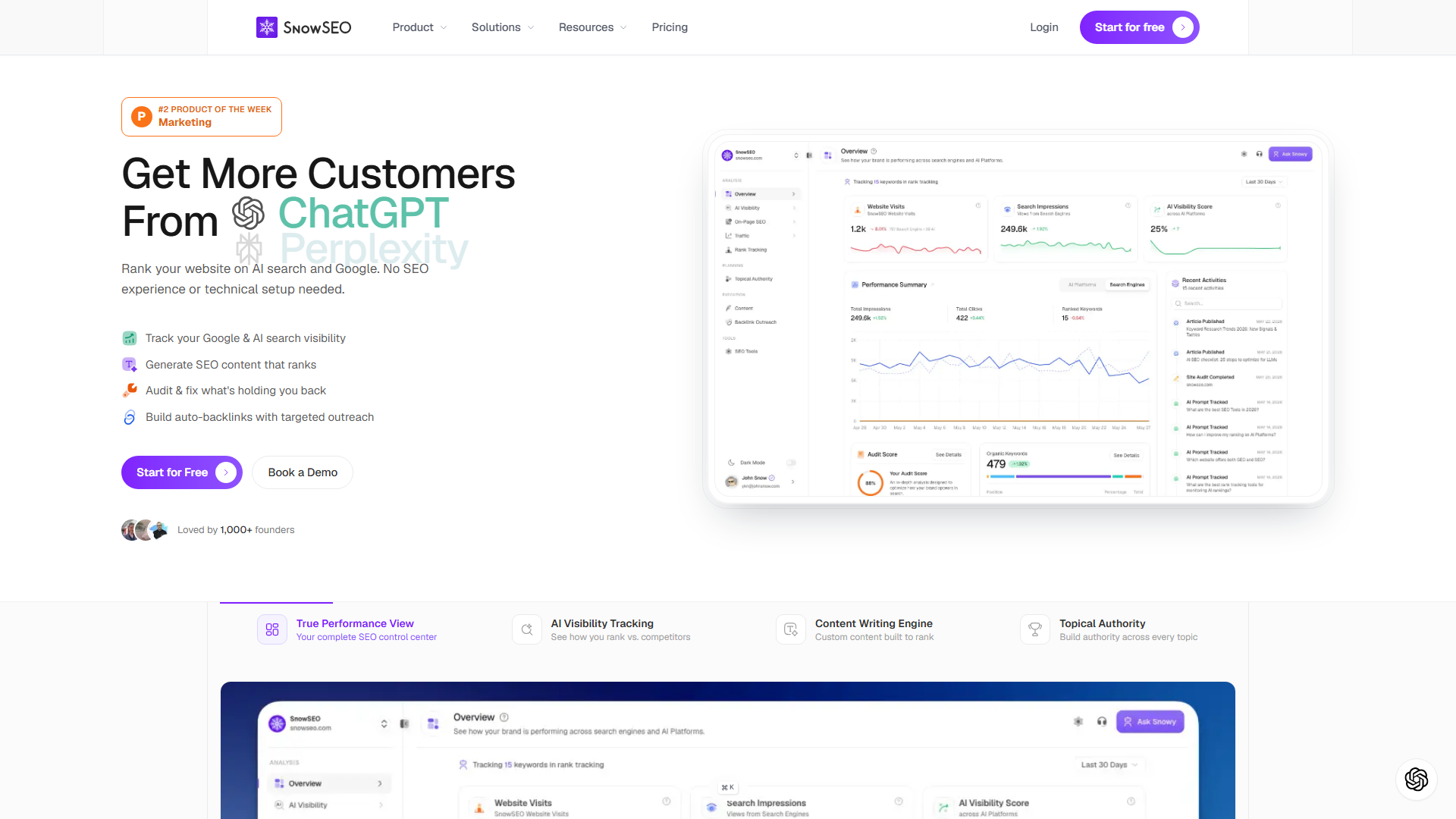
    SnowSEO puts classic SEO tracking and AI search visibility in one place. It helps you see how your brand shows up in both Google and AI answers, so you are not guessing where you win or lose attention. According to the SnowSEO overview, teams can track rankings, AI mentions, and site health in a single dashboard.

    SnowSEO
    SnowSEO

    Highlights

    • AI search visibility tracking across engines and AI platforms
    • Keyword research and rank tracking
    • Website audits and technical health checks
    • REST API support for custom reporting

    ​

    Specs

    • Best for: Teams prioritizing AI search visibility and modern SEO intelligence
    • Competitive research depth: Moderate
    • AI/GEO visibility: Strong focus on Generative Engine Optimization
    • Reporting: Good, with sharable and automated reports

    ​

    Pros

    • Built around AI-search-era visibility needs
    • Useful for both SEO and brand mention tracking in AI answers
    • API helps plug data into your own BI or dashboards, as shown in the reporting guide

    ​

    Cons

    • Less established than legacy enterprise suites
    • Competitive data depth may be narrower than top incumbents

    ​

    SnowSEO ranks first here because it directly targets SEO plus GEO, which fits 2026 competitive intelligence needs.
    Last updated: June 3, 2026

    Also Read: Content Gap Analysis Vs Content Audits Ultimate Guide

    2. Semrush One

    Semrush One gives you a broad competitive research platform that blends SEO, AI discovery, and prompt-level insight. You get classic keyword, backlink, and domain tools plus an AI Visibility Toolkit, which makes it useful for 2026 reporting across both search and AI surfaces.

    Semrush One
    Semrush One

    Highlights

    • Deep competitor research across keywords, backlinks, and traffic
    • Visibility overview for Google, AI Overviews, and LLMs
    • Prompt research to find natural language queries in your space
    • AI traffic dashboard to estimate visits driven by AI agents

    ​

    Specs

    • Best for: All-in-one competitive SEO and AI visibility
    • Competitive research depth: Strong, with domain, keyword, and market reports
    • AI/GEO visibility: Strong AI visibility toolkit with prompts and share-of-voice tracking
    • Reporting: Strong cross-channel and AI reporting

    ​

    Pros

    • Very broad feature set across SEO and AI visibility
    • Strong for competitor benchmarking in both search and AI
    • Useful AI traffic dashboard and visibility reports, as covered in the AI visibility features guide

    ​

    Cons

    • Can feel complex for smaller teams because it merges many workspaces
    • Pricing starts at the higher end, with Semrush listing Semrush One above standard SEO plans in its plans comparison

    ​

    It ranks near the top because it joins traditional competitor research with AI-era discovery and tracking, making it one of the most complete SEO intelligence tools for 2026.

    Last updated: June 3, 2026

    ​

    Also Read: Competitor Seo Monitoring 10 Powerful Tools To Track Wins

    3. Ahrefs

    Ahrefs is a deep SEO intelligence tool that helps you see what rivals rank for, where they earn links, and which content you are missing. It is one of the most trusted competitive SEO tools for teams that live inside backlink and keyword data.

    Ahrefs
    Ahrefs

    Highlights

    • Site Explorer for full domain and page level recon on traffic, keywords, and links, as shown in Ahrefs’ Site Explorer overview
    • Content Gap analysis to find keywords competitors rank for but you do not, backed by the Content Gap feature
    • Link Intersect to spot domains that link to your rivals but not to you
    • Rank tracking to watch key positions across markets

    ​

    Specs

    • Best for: Deep competitor and backlink analysis
    • Competitive research depth: Very strong
    • AI/GEO visibility: Moderate
    • Reporting: Strong
    • Focus: Backlinks, content gaps, ranking data

    Pros

    • Excellent competitor analysis depth
    • Industry leading backlink index
    • Strong keyword and content gap workflows

    Cons

    • AI visibility is less central than newer GEO focused tools
    • Can be more than small teams need

    Ahrefs ranks here because it is still a top tier competitor analysis tool when you want real backlink and keyword intelligence, not just pretty dashboards.

    ​

    Last updated: June 3, 2026

    4. Similarweb

    Similarweb gives you a full digital market view, not just SEO data. You see how competitors win traffic across search, social, referrals, and ads, which makes it easier to plan channel mix and budget. That broader digital competitive intelligence helps you explain performance to non-SEO leaders.

    Similarweb
    Similarweb

    Highlights

    • Digital market and industry benchmarking across sites and apps, useful for sizing markets and spotting threats, supported by Similarweb’s market research tools.
    • SEO tools suite with rank tracking, keyword analysis, and site reviews, built for data and AI driven search analysis as outlined in Similarweb’s SEO suite overview.
    • Rank tracking that covers classic SERPs and richer result types.
    • Search ads analytics to reverse engineer competitor PPC and blended search strategy.

    ​

    Specs

    • Best for: Broader competitor benchmarking
    • Competitive research depth: Strong
    • AI/GEO visibility: Moderate
    • Reporting: Strong
    • Focus: Market, search, and channel intelligence

    ​

    Pros

    • Strong market context beyond pure SEO.
    • Great for benchmarking traffic and channel mix.
    • Fits larger strategy, BI, and growth teams.

    ​

    Cons

    • Not as SEO-specialized as narrow SEO platforms.
    • Can feel heavy for small teams that only need keyword tracking.

    ​

    It ranks here because pairing SEO data with wider market and channel intelligence usually leads to better competitive strategy for bigger teams and agencies.

    Last updated: June 3, 2026

    ​

    Also Read: Competitive SEO Intelligence: build a tracking playbook

    5. SE Ranking

    SE Ranking is a well-balanced SEO platform that gives you competitive research, rank tracking, and reporting in one place. It now adds AI search visibility tracking, so you can see how both Google and AI engines treat your site compared to competitors. It suits teams that want strong SEO intelligence tools without jumping into heavy enterprise contracts.

    SE Ranking
    SE Ranking

    Highlights

    • Competitor traffic research across organic and paid
    • AI search visibility tracking for generative engines
    • Central SEO dashboard with ranks, health, and visibility
    • Detailed SERP and keyword tracking

    ​

    Specs

    • Best for: Balanced competitive SEO reporting
    • Competitive research depth: Strong, including SEO and PPC insights
    • AI/GEO visibility: Strong via dedicated AI visibility tools
    • Reporting: Strong dashboards and exports for agencies and teams
    • Focus: SEO, reporting, and AI search tracking

    ​

    Pros

    ​

    Cons

    • Less brand recognition than Ahrefs or Semrush
    • Some enterprises may still need deeper custom research and data exports

    ​

    SE Ranking ranks here because it blends core competitive SEO tools with modern AI visibility tracking in a package most teams can actually use every day.

    Last updated: June 3, 2026

    Also Read: Organic Growth Tactics Review Ultimate Tools Comparison

    6. Surfer SEO

    Surfer SEO started as a content optimization tool and now leans hard into SEO intelligence. It helps you map topical authority, optimize content against live SERPs, and track how often AI systems surface your brand and competitors.

    Surfer SEO
    Surfer SEO

    Highlights

    • Content Editor for SERP-aligned briefs and real time on-page guidance, backed by ranking signals, according to the Surfer Content Editor overview.
    • AI Tracker to monitor brand and competitor visibility across major LLMs and AI search surfaces, as shown in Surfer’s AI Tracker docs.
    • Topical Map to plan clusters, fill gaps, and grow topical authority.
    • Content audits to refresh and re-target underperforming URLs.

    Specs

    • Best for: Content teams and topical strategy
    • Competitive research depth: Moderate
    • AI/GEO visibility: Strong
    • Reporting: Moderate
    • Focus: Content optimization and AI visibility

    ​

    Pros

    • Excellent for content optimization against intent and entities.
    • Strong AI visibility tracking workflow across multiple sources.
    • Helpful topical cluster and gap analysis.

    Cons

    • Not a full competitor suite for links or technical intel.
    • Limited if you only care about backlink data.

    ​

    Surfer ranks here because it covers a key layer of competitive SEO intelligence: content performance, topical coverage, and AI search visibility.

    Last updated: June 3, 2026

    Also Read: Cms Integrations For Seo Powerful Technical Setup Guide

    How to choose the right SEO intelligence tool

    Start with the main signal you care about most:

    • Backlinks: Pick a tool with strong link index, toxic link flags, and competitor link gap reports.
    • Keyword gaps & content: You need keyword gap analysis, topic clusters, and SERP feature tracking.
    • Rank tracking: Go for granular daily tracking by device, location, and tag.
    • Traffic benchmarking: Choose tools with clickstream/traffic share data, not just rankings.
    • AI visibility: Shortlist platforms that track AI Overviews and LLM mentions, not only blue links.

    ​

    Match features to how your team works:

    • Daily reporting & many stakeholders: Look for live dashboards, scheduled PDF/Slack/email reports, and API access for your data warehouse.
    • AI Overviews / LLM citations: Check that the roadmap and UI clearly show AI placement, sources, and history. Tools like SnowSEO focus on GEO signals across Google and major AI models.
    • Content-led teams: You want topical mapping, content audits, and page-level suggestions tied to impact, not vague scores.
    • Agencies / large teams: Prioritize multi-domain monitoring, portfolio views, competitive benchmarking, and white-label exports.

    ​

    Balance depth with ease of use. The right tool is the one your team actually opens every week and can act on without training marathons.

    Homepage
    Homepage

    ​

    Ready to turn competitor insight into action instead of another report? Plug what you learned from these 12 tools into SnowSEO to combine SEO audits, GEO visibility, competitive tracking, and done-for-you content in one dashboard. Start your next growth sprint today.

    Frequently Asked Questions

    Q1: Which competitive SEO intelligence tools best track AI overviews in 2026?

    Look for tools that track AI answer boxes across Google, ChatGPT, and other assistants, not only SERP snippets. Platforms like SnowSEO and a few newer GEO-focused suites log AI mentions, URLs cited, and ranking shifts side by side with classic SEO data.

    Q2: How do I choose the best SEO + GEO tool for competitor visibility tracking?

    Start with your main channels: Google, YouTube, and key AI assistants. Check if the tool tracks AI answers, supports your country and language, and has clean reporting. Then compare pricing, user seats, and how easily your team can act on the insights.

    Q3: What features should a 2026 competitive SEO tool have for daily reporting?

    You need daily keyword and URL movements, AI overview presence, and alerts for big wins or losses. Also useful: competitor content launches, featured snippet changes, click-through estimates, and a simple dashboard that non-SEOs on your team can read in seconds.

    Q4: How often should I update my competitor list in these tools?

    Review your list every quarter, or sooner after big funding rounds, product launches, or traffic drops. Add fast-growing niche players, remove dead sites, and tag direct vs indirect competitors so your reports stay focused on real threats.

    ​

  • Keyword Research Trends 2026: New Signals & Tactics

    Keyword Research Trends 2026: New Signals & Tactics

    Keyword research in 2026 is no longer just about finding search terms – it is about decoding intent, SERP behavior, and AI-driven visibility signals.

    Many SEO teams still lean on static keyword lists and rank checks that miss how search now groups topics, rewrites queries, and surfaces AI answers ahead of blue links.

    This guide breaks down the key trends and shows how to adapt with intent-first clustering, deeper SERP analysis, and new performance metrics built for AI Overviews and topic-based ranking.

    Quick Summary: Keyword research in 2026 is shifting from static keyword lists and rank tracking to intent maps, topic clusters, and SERP-first analysis that account for AI Overviews and assistant-driven search. The article argues that SEO teams should group queries by entity and business intent, build one hub with supporting content, and prioritize high-value clusters rather than chasing individual high-volume terms. It also stresses that success metrics must expand beyond single-keyword rankings and raw traffic to include cluster visibility, AI citations, engagement, and conversions, while still keeping fundamentals like crawlability, internal linking, and useful content in place.

    What changed in keyword research in 2026

    1. From keyword lists to intent maps

    Keyword research in 2026 is less about volume and more about patterns. You are not chasing 500 loosely related terms anymore.

    You map how topics, entities, and intents connect across a journey. As serpnap.com notes, one strong page can rank for 200+ variations if it fully covers an entity.

    So your workflow shifts from:

    • Export list
    • Pick top volume
    • Write 1 post per keyword

    To:

    • Cluster terms by problem and persona
    • Plan one hub plus supporting content
    • Measure outcomes at the cluster level
    Workflow diagram illustrating keyword research process
    Workflow diagram illustrating keyword research process

    If your research does not show clear intent groups, you are still doing 2018 SEO.

    2. Why AI Overviews changed the game

    AI Overviews cut clicks hard. One study cited by rankenstein.pro shows organic CTR dropping about 61 percent when AI Overviews appear.

    So the question is not only “What do people type?” but “Which questions trigger AI answers where I can be cited?” That is why keyword research now feeds:

    • Generative Engine Optimization
    • Prompt research for AI assistants
    • Entity and brand positioning

    You still care about search volume. But you care more about:

    • How often AI rewrites that query into a broader question
    • Whether your brand is a natural source to quote

    Your keyword list is now your training set for AI, not just your content calendar.

    3. The rise of topic clusters and semantic coverage

    Google and AI systems read context, not just strings. They look for entities, relationships, and semantic coverage instead of raw repetitions.

    Keyword stuffing is not only useless, it is a negative signal, as explained on serpnap.com. You win by showing depth around a topic: definitions, use cases, comparisons, and edge cases.

    That is why topic clusters dominate 2026 workflows:

    • One pillar targets the core entity
    • Cluster pages handle specific intents
    • Internal links show the knowledge graph of your site

    SnowSEO leans into this by tying keyword data to clusters and GEO signals, so you are not guessing which topics AI engines already see you as an authority on.

    In 2026, the best “keyword strategy” is really a semantic coverage strategy.

    Also Read: SEO Platform in 2026: What to Look For and Why

    How to research keywords now

    Keyword research in 2026 is less about lists and more about patterns. Think signals, not single phrases.

    1. Start with SERP analysis, not volume

    Open the SERP before you open a keyword tool. Ask: what is Google trying to solve here?

    Scan:

    • Mix of pages (guides, tools, product pages, forums)
    • SERP features (AI Overviews, People Also Ask, videos, shopping)
    • Who owns the top 5 spots and why

    This tells you intent and content format. High volume is useless if the SERP is locked up by giants or informational-only pages that never convert. Current guidance on AI era SEO from serpnap.com backs this focus on clusters and intent over raw counts.

    Pencil sketch of SERP on monitor
    Pencil sketch of SERP on monitor

    2. Use AI clustering to group related queries

    Stop treating each keyword as a new page. Group them.

    Use AI or clustering tools to:

    • Combine close variants into one topic
    • Map supporting questions around a core query
    • Spot gaps competitors do not cover

    Platforms like SnowSEO and Surfer SEO already cluster by intent pattern, so you see topics, not noise.

    3. Prioritize by intent and business value

    Score each cluster on:

    • Intent: learn, compare, buy
    • Match with your offer
    • Revenue potential

    Then build:

    1. Bottom funnel clusters first (money pages)
    2. Comparison and “best” clusters
    3. Broad educational hubs that feed internal links

    This lines up with how prompt driven AI recommendations work in research from semrush.com: decision moments beat vague questions.

    Also Read: AI SEO: 25 tactics to rank faster in 2026

    How to measure keyword success in 2026

    Keyword success in 2026 is not a rank report. It is how often you win across both search and AI.

    1. Track cluster visibility instead of single-keyword rank

    Stop obsessing over one keyword in position 3 vs 5. Track how a topic cluster performs across:

    • Google SERPs
    • AI Overviews
    • AI engines like ChatGPT, Perplexity, and Gemini

    AI search pulls passages, not pages. Success looks like repeated citations from the same cluster. Platforms like SnowSEO help by tracking both keyword rankings and AI mentions in one view, so you see cluster level impact, not random spikes. surferstack.com

    2. Use engagement and conversion signals

    Tie clusters to:

    • Scroll depth and time on page
    • Assisted conversions in GA4
    • AI referred traffic from chat.openai.com or perplexity.ai

    AI traffic often converts better, as noted in fieldnotes.growthmarshal.io, so treat those sessions as high value.

    3. Know which old metrics to de-prioritize

    Still reporting “organic sessions” and “average position” as your main KPIs? You are flying blind.

    De-prioritize:

    • Single keyword rank screenshots
    • Raw organic traffic volume
    • Vanity impressions with no intent

    Prioritize:

    • LLM citation rate for your key prompts
    • Share of citations vs competitors
    • Branded search lift after AI visibility spikes

    Think less “Did I rank for this exact keyword?” and more “Did this cluster change how search and AI talk about us?”

    Also Read: Best SEO Tools: 25 Picks to Improve Rankings in 2026

    Practical takeaways for SEO and content teams

    1. What to keep, what to change

    Keep the basics: crawlability, internal links, useful content, and solid backlinks. Google’s own AI guidance says the same foundations still drive visibility in AI features too, not just blue links, as covered on previsible.io.

    Change how you use keywords. Treat them as scaffolding, and let search intent and entities shape topics, as frameworks like rankenstein.pro suggest.

    Shift goals from “rankings only” to “rankings + AI citations.” You write for Google, AI Overviews, and assistants like ChatGPT at the same time.

    2. A 2026 keyword research checklist

    Use this quick list when you plan new content:

    • Map queries to intent, not just volume.
    • Cluster related keywords around one entity-driven topic.
    • Check AI Overviews and assistants to see which answers already show.
    • Flag gaps where AI gives vague or weak responses.
    • Prioritize queries where you can add original data, clear steps, or strong comparisons.

    3. Where this strategy fits in your content plan

    You plug this into planning, not just into one-off posts.

    At quarterly planning, build topic clusters first, then assign content by intent stage:

    • Awareness: broad, educational hubs.
    • Consideration: comparison, “best X for Y,” and solution guides.
    • Decision: product, pricing, integration, and implementation pages.

    For each piece, set two success metrics:

    1. Classic SEO: impressions, clicks, conversions.
    2. AI presence: how often your brand or page appears in AI Overviews and assistant answers.

    Platforms like SnowSEO make this easier by tying keyword clusters, content briefs, and performance tracking into one workflow so your team is not stitching five tools together.

    Review one existing keyword cluster this week and update it for 2026 search behavior using SnowSEO to guide decisions.

    Screenshot of the SnowSEO homepage dashboard for keyword research and topic clustering
    Homepage

    Frequently Asked Questions

    Q1: How often should I update keyword research in 2026?

    Review core keywords quarterly and high impact pages monthly. Watch shifts in AI Overviews, SERP features, and conversion data. If impressions drop, intent changes, or new queries appear in Search Console, update clusters and on page content right away. Treat it as ongoing, not a project.

    Q2: How do I align keyword research with AI Overviews?

    Start from user tasks, not exact phrases. Map questions, comparisons, and step sequences people need. Group them into tight clusters and cover each cluster with one strong hub and several supports. Tools like SnowSEO can link intents, entities, and content gaps in one view.

    Q3: What happens if I only chase search volume?

    You get traffic that looks good in reports but does not convert. High volume terms in 2026 are often vague, branded, or informational. Focus on intent density inside a cluster, not only single volume numbers. Better to own a smaller, high intent universe than a noisy one.

    Q4: Who benefits most from cluster based keyword research?

    Agencies get cleaner reporting and repeatable playbooks. E commerce teams see clearer links between category clusters and revenue. Small businesses use clusters to avoid wasting time on random blogs. Anyone who needs focus, scale, and clear ROI from content wins with this approach.

    Conclusion

    Keyword research in 2026 is still essential, but it now centers on intent and topic coverage, not single phrases. AI Overviews and semantic search make SERP and feature analysis more important than raw volume alone, especially as ai-powered search expands. Cluster-based planning and measurement are replacing single-keyword thinking. Teams that blend AI speed with human judgment will outrun competitors clinging to outdated workflows.

  • AI SEO checklist: 25 steps to optimize for LLMs

    AI SEO checklist: 25 steps to optimize for LLMs

    Most AI SEO articles explain what LLMs are. This one tells you what to fix, in order, so LLMs can crawl, understand, cite, and surface your content.

    Teams ship solid content that still fails in AI search because of weak access, messy structure, vague entities, and no citation signals.

    This checklist gives 25 clear steps across access, structure, authority, and measurement. It is built for SEO teams and marketers who need a repeatable 2026 ready audit framework, not theory.

    Quick Summary: The article lays out a practical 25-step AI SEO checklist for improving visibility in LLM-driven search, emphasizing what to fix first so AI systems can crawl, understand, cite, and surface content. The steps are grouped into four main areas: technical access and indexability, content structure for easy parsing, entity/trust signals like schema and authorship, and measurement/iteration to track AI mentions, citations, and conversions. It also shows how to adapt the checklist for B2B, SaaS, e-commerce, and agency workflows, while warning that blocking AI bots, relying on JavaScript-only pages, burying answers, or failing to measure AI referrals can sharply reduce visibility.

    25-step AI SEO checklist for LLM visibility

    You want LLM visibility fast. Use this as a punchy, go / no-go checklist before you publish.

    1. Check access and indexability first

    1. Confirm your site is crawlable in Google Search Console and Bing Webmaster Tools.
    2. Test key URLs with URL Inspection to spot noindex or canonical issues.
    3. Allow GPTBot, ClaudeBot, PerplexityBot in robots.txt as suggested in the gist.github.com GEO cheatsheet.
    4. Create an llms.txt file listing your key pages and topics.
    5. Submit XML sitemaps to both Google and Bing.
    6. Check page load time – aim under 2 seconds on mobile.
    7. Verify HTML content is present without heavy JS rendering.
    Checklist on clipboard with AI SEO steps
    Checklist on clipboard with AI SEO steps

    2. Make pages easy for LLMs to parse

    1. Use one H1 and clear H2 / H3 hierarchy, like the LLM factor guide on rankio.studio.
    2. Add a 1 to 2 sentence direct answer in the first 200 words.
    3. Break text into short paragraphs and bullets.
    4. Turn comparisons and feature lists into HTML tables.
    5. Add a 3 to 5 question FAQ section on each key page.
    6. Standardize terminology for products, features, and audiences.
    7. Use descriptive, question style headings where it fits.

    3. Add entity and trust signals

    1. Implement Organization, Article, and FAQPage schema.
    2. Add author names, bios, and real photos.
    3. Show first hand data, case studies, or screenshots.
    4. Link out to primary research and official stats (gov, edu, or major orgs).
    5. Keep NAP details consistent with your profiles and directories.
    6. Pursue at least one external mention you do not control, as suggested in loamly.ai.

    4. Instrument measurement before publishing

    1. Tag key events and goals in GA4 for signups, leads, and trials.
    2. Create segments for likely dark AI traffic: direct + brand new users.
    3. Track Bing organic and AI related queries separately in Search Console.
    4. Log AI visibility tests for ChatGPT, Claude, and Perplexity monthly.
    5. Use a GEO audit tool like SnowSEO or llmpulse to track AI visibility over time.

    Also Read: 11 AI Content Generation workflows to publish faster

    The 25 steps, grouped by what matters most

    Think of this checklist as four buckets. You tighten technicals, then structure, then authority, then feedback loops.

    1. Technical foundation steps

    1. Fix HTTPS, core web vitals, and clean URLs.
    2. Set a single H1, logical H2 / H3 tree.
    3. Add unique title and meta description to every page.
    4. Implement canonical tags and fix duplicates.
    5. Open robots.txt to AI crawlers like GPTBot and ClaudeBot, as advised in aiplusautomation.com.
    6. Add core schema types per page (Article, Organization, FAQ, Product where relevant) and hit high attribute completeness.
    7. Create XML sitemaps and submit via Google Search Console.
    8. Run a full SEO + GEO audit with a platform like SnowSEO and fix sitewide issues.
    Workflow diagram illustrating AI SEO steps
    Workflow diagram illustrating AI SEO steps

    2. Content structure steps

    1. Lead with a crisp answer in the first 2 to 3 lines.
    2. Use short paragraphs, bullets, and tables, which helps LLM parsing as noted by snowseo.com.
    3. Match page format to query intent (how to, comparison, review, FAQ).
    4. Add explicit definitions for key entities and terms.
    5. Layer internal links between pillar pages and clusters.
    6. Add FAQ sections that mirror real user questions.

    3. Authority and citation steps

    1. Add clear author bylines and bios.
    2. Show publish and update dates.
    3. Cite primary sources with inline links, not vague claims.
    4. Add original data, examples, or mini case studies.
    5. Build niche depth with at least 15 to 50 focused pages.
    6. Use consistent brand language so AI can recognize you.

    4. Measurement and iteration steps

    1. Track AI mentions and GEO performance with SnowSEO or llmpulse.
    2. Monitor organic rankings and clicks via GSC.
    3. Measure AI-driven traffic quality in GA4.
    4. Re run target prompts quarterly across major LLMs and log citations.
    5. Refresh high value pages at least twice a year based on these insights.

    Also Read: AI Content Generation: Complete 2026 Strategy Guide

    How to apply the checklist to B2B, SaaS, or e-commerce pages

    1. B2B and SaaS pages

    Start with your core funnels: home, product, pricing, and main feature pages.
    Turn each into an answer first page with a clear 40 to 60 word value summary at the top.
    Add definition blocks for your product category and buyer problems, then link to deep-dive resources in your complete guide to AI SEO checklist content.

    2. E-commerce pages

    Pick top revenue categories and best sellers.
    Tighten product descriptions, add spec tables, and short FAQs.
    Give each product a clean, self-contained block LLMs can quote.

    3. Agency and content team workflow

    Use one shared checklist for briefs, drafts, and QA.
    SnowSEO helps teams map topics, generate drafts, and keep structure consistent.

    Also Read: AI SEO: 25 tactics to rank faster in 2026

    Mistakes that reduce LLM visibility

    1. Common technical mistakes

    Block AI crawlers in robots.txt and you vanish from LLM indexes. Research from llmvlab.com shows this is the top issue. JavaScript-only pages are another killer, since most AI bots do not render them. Slow servers and messy sitemap structures also hurt crawl coverage. You need clean robots rules, server side rendering for key pages, and fast load times so engines can actually fetch and index your content.

    2. Common content mistakes

    Bury the answer and LLMs skip your page. GEO guides like truperformance.us stress answer first writing, but many teams still open with fluff. Thin, generic content with no stats or clear claims gives engines nothing quotable. No FAQs, no headings that echo user questions, and weak on page structure all reduce extraction odds. You should write short, direct answer blocks and section level insights that stand alone.

    3. Common measurement mistakes

    Teams often track only organic traffic, not AI referrals or citation rates. That hides both wins and problems. Another mistake is not logging 404s from AI driven visits, so hallucinated URLs keep leaking conversions. Some teams even treat GEO and SEO as one metric, mixing signal. You should segment LLM traffic in GA4, track AI mentions with tools like SnowSEO, and watch how changes affect prompts, citations, and conversion rates over time.

    Use this checklist on your top pages today, then visit our AI SEO pillar page for strategy, and run them through SnowSEO for instant Generative Engine Optimization insights.

    Homepage
    Homepage

    Frequently Asked Questions

    Q1: How often should I run the AI SEO checklist for LLMs?

    Run a light version weekly and the full 25 step checklist monthly. Increase to bi weekly if you ship lots of new content or change your site structure.

    Q2: What is the first thing to fix for better LLM visibility?

    Start with clean, crawlable structure and fast pages. Fix broken links, thin content, and unclear internal links. LLMs lean on solid source sites, so technical basics matter more than clever prompts.

    Q3: How do I know if LLM traffic is improving?

    Track branded and non branded queries where users mention ChatGPT, Claude, or AI in your analytics notes. Watch for more assisted conversions and referrals from AI powered tools, feedback in sales calls, and higher rankings on informational queries tied to your brand.

    Q4: Do I need a tool like SnowSEO for this checklist?

    You can do most steps by hand, but it is slow. A platform like SnowSEO bundles audits, content checks, and tracking for both search and LLM exposure, so you actually keep the checklist running instead of letting it die after week one.

    Conclusion

    LLM SEO is not magic, it is systems work. When technical access, extractable structure, real authority, and clean measurement line up, visibility compounds. Research on AI citations from sources like semrush.com and geodaddy.dev backs this up. A focused 25 step checklist beats vague tips every time.

  • AI Content Marketing vs PromptWatch: Which Wins?

    AI Content Marketing vs PromptWatch: Which Wins?

    AI content marketing tools and PromptWatch solve different problems, but many buyers compare them like direct substitutes.

    That mix up blows budgets, breaks workflows, and hides chances to win on both content production and AI search visibility.

    This guide shows what each category does, who each is for, how they fit in a modern SEO stack, and which path gives you the best value for your goals.

    You get straight, practical advice built for marketers in a real buying stage.

    Quick Summary: AI content marketing tools and PromptWatch are not true substitutes: the former is built for research, drafting, and SEO optimization at scale, while PromptWatch is a GEO and AI search visibility platform that tracks when and why brands are mentioned in ChatGPT, Claude, Perplexity, Gemini, and similar systems. The article compares them by use case, showing content tools are strongest for producing lots of articles and ranking on Google, whereas PromptWatch is strongest for monitoring prompts, citations, competitors, and AI-specific visibility gaps. It also notes that SnowSEO sits between the two by combining content execution with some AI visibility features, making it a practical middle ground for teams that want both. The main caveat is that the right choice depends on your bottleneck, budget, and team size: use a content tool when you need volume, PromptWatch when you need AI visibility, and a blended stack when you need both.

    What AI Content Marketing Tools Actually Do

    AI content tools handle the grunt work of research, drafting, and optimization so you can focus on strategy and editing. Think of them as an extra pair of fast, average-smart hands that never get tired.

    1. Core features and workflows

    Most platforms follow a similar flow:

    1. Research

      • Pull keyword ideas and search intent.
      • Analyze competitors and content gaps.
      • Some, like SnowSEO, fold this into a full SEO + AI audit so you see both Google and AI engine demand in one place snowseo.com.
    2. Planning and briefs

      • Auto-generate outlines, headings, and semantic keywords based on what already ranks snowseo.com.
      • Score difficulty and suggest target length.
    3. Drafting and optimization

      • Create first drafts for blogs, landing pages, and more.
      • Live SEO scoring, readability checks, and internal link ideas.
      • Some tools even push content straight to your CMS.

    2. Who benefits most

    • Lean SEO teams that need scale without hiring 3 more people.
    • Agencies running content for many clients at once.
    • SMBs that want search traffic but hate keyword spreadsheets.
    • Founders who know their story but stall at a blank page.

    Also Read: AI SEO: 25 tactics to rank faster in 2026

    What PromptWatch Does and Why It Matters

    PromptWatch is not a classic AI content tool. It is an AI search visibility and GEO platform that shows how often, where, and why AI models mention your brand across ChatGPT, Claude, Perplexity, Gemini and more, based on real UI prompt data and crawler logs from user interfaces, not APIs, as explained on promptwatch.com.

    Dashboard displaying comparative marketing charts
    Dashboard displaying comparative marketing charts

    1. Visibility tracking versus content creation

    PromptWatch starts with tracking:

    • Which prompts your customers actually ask.
    • How often your brand appears vs competitors.
    • Which URLs AI models cite in their answers.
    • When AI crawlers hit your site in real time.

    From there, it layers optimization: content gap analysis, AI content suggestions, and an AI writer tuned to produce pages more likely to be cited in AI answers, based on billions of citations processed, as outlined on ai-search-tools.com.

    So while tools like SnowSEO focus on doing the content and SEO execution, PromptWatch is the radar and control tower for AI search.

    2. Best-fit use cases

    PromptWatch is best when you:

    • Already ship decent content, but have no idea how AI models treat it.
    • Need to report AI visibility for multiple brands or markets.
    • Want to treat AI search like a new SERP you must own, prompt by prompt.

    Also Read: 11 AI Content Generation workflows to publish faster

    AI Content Marketing vs PromptWatch: Which Wins for Your Team?

    You are really choosing between two jobs:

    • AI content marketing tools that pump out SEO content
    • PromptWatch that shows where AI models actually mention you and why

    1. Side-by-side comparison by use case

    Need AI content marketing tools PromptWatch
    Produce lots of blog posts Strong Weak
    Optimize for Google Strong Limited
    Track visibility in ChatGPT, Claude, Perplexity Weak Strong
    See answer gaps and prompts competitors win None Strong
    Connect AI visibility to traffic and revenue None Strong

    SnowSEO sits closer to the content side, like Surfer SEO or Writesonic, but adds AI visibility tracking, so it overlaps both worlds.

    Comparison table of AI marketing tools
    Comparison table of AI marketing tools

    2. Which teams should choose which tool

    Pick AI content marketing tools / SnowSEO if you:

    • Need 20 to 50 SEO articles a month
    • Care most about Google rankings and basic AI coverage
    • Have thin processes and need automation

    Pick PromptWatch if you:

    • Need to know which prompts mention you
    • Care how ChatGPT, Claude, and others cite you
    • Already have writers or tools to create content

    3. Decision factors that matter most

    Focus on:

    1. Primary channel – Google first vs AI assistants first
    2. Team size – tiny team needs automation, larger team can handle PromptWatch workflows
    3. Budget vs depth – PromptWatch is a premium AI visibility stack like toolsolved.com; pure writers stay cheaper

    If you want both volume and AI visibility in one place, SnowSEO is often the pragmatic middle ground.

    Also Read: AI Content Generation: 25 prompts to write winning blogs

    How to Choose the Right Stack for AI Content and GEO

    Start with a simple rule: content tools create demand, GEO tools make sure AI can find it.

    1. Simple selection framework

    Use this 4 step filter:

    1. Goal first

      • Need more content fast: pick an AI content platform.
      • Need more AI citations: prioritize GEO visibility tools.
    2. Team size

      • Solo / small team: choose integrated platforms like SnowSEO or PromptWatch that bundle content and GEO in one workflow.
      • Larger teams: pair a specialist writer (Writesonic, Surfer SEO) with a GEO tracker.
    3. Budget band

      • Under 200/month: 1 all in one tool.
      • 200 to 500/month: 1 content tool + 1 GEO tool.
    4. Action over dashboards
      Choose tools that show gaps and help you fix them, not just report problems.

    Choose the tool that matches your current bottleneck, then book a demo or trial to validate fit with your workflow.

    Homepage
    Homepage

    Frequently Asked Questions

    Q1: Is PromptWatch an AI content tool or a tracking tool?

    PromptWatch is a tracking and monitoring tool, not a writer. It helps you see how AI systems respond to prompts, spot changes, and log outputs over time.

    Q2: When does AI content marketing beat PromptWatch?

    AI content marketing tools win when your core problem is scale. You need more high quality pages, faster, for SEO, email, or ads. PromptWatch will not fix a thin content pipeline.

    Q3: When does PromptWatch matter more than content tools?

    PromptWatch matters more when you already ship lots of AI content and prompts. You care about guardrails, QA, and consistent output across teams and clients.

    Q4: Where does SnowSEO fit between AI content and PromptWatch?

    SnowSEO sits on the execution side. It helps you research keywords, generate SEO content, and track rankings in one place. Pair it with PromptWatch if you also need deep prompt logging and AI behavior tracking.

    Conclusion

    AI content marketing tools speed up execution, while PromptWatch shines for AI visibility tracking and GEO measurement. Research on generative AI in marketing shows strong gains when humans steer strategy and review output, not just automate everything alone, as noted by mckinsey.com.

    Pick based on your main bottleneck: content production, visibility monitoring, or both. For most teams, a blended stack wins.

  • 11 AI Content Generation workflows to publish faster

    11 AI Content Generation workflows to publish faster

    If your content team is using AI but still publishing slowly, the bottleneck is probably the workflow, not the writing.

    Most teams generate drafts faster with AI, but lose time in brief creation, revisions, SEO checks, approvals, and publishing handoffs.

    This article breaks down 11 AI content generation workflows into one repeatable, faster path from brief to publish, with built-in SEO, GEO, and CMS steps. Built for SEO teams and content operators who want a practical, scalable process, not another tool list.

    Quick Summary: The article argues that slow content publishing is usually a workflow problem, not an AI-writing problem, and lays out 11 practical AI content generation steps to move from brief to publish faster. It emphasizes a brief-first process, section-level prompting instead of generating full drafts at once, and a repeatable review-and-optimization stage that includes human fact checks, SEO structure, schema, internal linking, and GEO considerations. It also recommends automating CMS handoff, indexing, and performance tracking so teams can scale without sacrificing quality, while noting that editors are still essential and that teams should start with just 1–2 workflows before expanding.

    1. Build the brief-first AI workflow

    Stop letting AI guess what to write. Make the brief the boss and everything speeds up.

    Use an AI writing assistant to turn a single keyword into a full SEO brief. Tools like SnowSEO already pull SERP data, competing headings, and semantic topics into one view, similar to what guides on writerush.ai describe. Drop in your primary keyword, confirm the search intent, then let the tool suggest H2s, FAQs, and internal link ideas. Edit that brief once, then hand it to writers or your AI drafting flow.

    Before anyone drafts, bolt on SEO and GEO checks. Your brief should spell out:

    • Target keyword and supporting terms
    • Search intent and content type
    • Internal links back to your complete guide to AI content generation workflows
    • GEO targets, like country or language, so examples match the market

    Platforms like SnowSEO go further by adding real time scoring and Generative Engine Optimization notes based on the kind of schema and intent work you see on inspace.io. That means your draft starts aligned with Google and AI search, not fixed later in a panic.

    Also Read: AI Content Generation: Complete 2026 Strategy Guide

    2. Draft faster with section-level AI prompts

    Stop asking AI for full 2,000 word posts in one shot. That is how you get fluff, repetition, and edits that take forever.

    Section-level prompts fix this. You guide each H2 like a mini task, so the draft stays sharp, on-topic, and easy to edit.

    1. Break the article into modular sections

    Start by locking your structure before you write.

    1. Define your H2 and H3 headings.
    2. Give each section one clear job.
    3. Note target keywords or questions per section.

    Example jobs:

    • H2: Problem – explain why this topic matters now.
    • H2: Process – show the step-by-step.
    • H2: Proof – add examples, data, or case studies.

    Tools like SnowSEO make this easy by auto-generating outlines from SERP analysis and letting you adjust H2s and H3s before any draft is written, similar to how planning first improves long-form quality in <a href="https://rephrase-it.com/blog

  • AI SEO: 25 tactics to rank faster in 2026

    AI SEO: 25 tactics to rank faster in 2026

    AI is no longer just helping you create SEO content. In 2026, it can help you decide what to publish, how to structure it, and how to earn visibility faster.

    Most teams use AI for speed, not for search performance. They crank out more content but do not gain rankings, citations, or conversions.

    This guide breaks down 25 AI SEO tactics for 2026 across content optimization, SERP-ready formatting, technical SEO, and AI visibility measurement. It is built for SEO teams and business owners who need practical, current tactics for Google, AI Overviews, and answer engines.

    Quick Summary: The article argues that AI SEO in 2026 is no longer just about producing content faster, but about improving rankings, citations, and conversions by aligning with how Google, AI Overviews, and answer engines now surface trusted answers. It organizes 25 tactics into three main buckets: content and intent optimization (answer-first intros, topic clusters, FAQs, schema, refreshes), SERP and AI Overview tactics (direct answers, rich snippets, citation tracking, credibility signals), and technical/authority work (crawl health, internal linking, schema validation, trusted mentions). A key nuance is that AI-generated drafts alone can hurt trust and performance, so the article stresses fact-checking, structured formatting, and ongoing updates rather than one-time publishing. It also emphasizes measuring AI visibility, citation frequency, sentiment, and business outcomes alongside traditional rankings, with the fastest improvements typically showing in 2 to 4 weeks for fixes and 2 to 3 months for larger gains.

    AI SEO in 2026: what actually moves rankings faster

    1. What changed in search this year

    Search now favors answers, not blue links. Google’s AI Overviews and AI assistants pull direct responses from a small set of trusted pages, so visibility shifted from just “rankings” to “being cited.” Research on answer engine behavior shows this click shift toward summaries, not classic SERPs, which matches what many teams feel in their traffic.

    Google also tightened spam and quality rules. Yoast’s April 2026 recap highlights tougher core and spam updates plus new AI agent signals that crawl and interpret content differently, with a stronger focus on trust and structure.

    AI intent modeling jumped ahead too. Engines read dwell time, follow up questions, and tone in real time, as recent Google intent modeling work shows. That means rankings can move minute by minute based on live behavior, not just old school keyword and link scores.

    2. Which AI SEO tactics affect rankings fastest

    If you want fast movement now, focus on:

    • AI intent research: Use platforms like SnowSEO to find actual questions users ask in search and AI tools.
    • Answer first content: Lead sections with a clear 40 to 80 word answer block that AI can quote.
    • Structured data: Use FAQ and Article schema so AI agents can extract clean chunks.
    • Cross engine optimization: Track both classic rankings and AI citations in one place so you react before drops stick.

    Also Read: AI Content Generation: 25 prompts to write winning blogs

    25 AI SEO tactics to implement first

    Start with what moves rankings and AI citations fastest. Use this list as your first 90‑day roadmap.

    1. Content and intent tactics

    These make your pages easier for AI and humans to understand.

    1. Map every keyword to a clear search intent.
    2. Rewrite key pages with answer‑first intros, like recommended in the AI SEO checklist on gagansheron.com.
    3. Build topic clusters around your core offers instead of random posts.
    4. Add FAQ sections to all major pages with tight Q&A pairs.
    5. Implement FAQ schema for those Q&As.
    6. Use AI to find missing subtopics and fill content gaps.
    7. Refresh at least your top 20 URLs with 2026 data, stats, and examples.
    8. Write in short paragraphs and simple language so AI can quote you cleanly.
    9. Add comparison tables, step lists, and pros/cons blocks to win snippets.
    10. Localize key content for your top markets instead of auto‑translate only.
    Cartoon workflow diagram with directional arrows
    Cartoon workflow diagram with directional arrows

    2. SERP and AI Overview tactics

    Here you chase rich features and AI Overviews.

    1. Target questions people actually ask in chat models, not just in Google.
    2. Format 40‑60 word direct answers under each H2.
    3. Add HowTo and Product schema where it fits.
    4. Use a rank tracker that also monitors AI Overview presence.
    5. Track how often you get cited in tools like ChatGPT and Perplexity, similar to the research approach on trakkr.ai.
    6. Add clear author bios and credibility signals on important pages.
    7. Design SERP‑feature ready templates for reviews, steps, and FAQs.

    3. Technical and authority tactics

    This stuff keeps the whole system stable.

    1. Fix crawl errors, broken links, and slow Core Web Vitals.
    2. Allow major AI crawlers unless your policy says otherwise.
    3. Validate all schema with a structured data tester.
    4. Clean up internal linking so key pages get most link equity.
    5. Build citations on trusted third‑party sites your audience reads.
    6. Strengthen profiles on platforms LLMs trust, like Wikipedia or major review sites.
    7. Monitor brand mentions in AI answers and correct wrong facts.
    8. Standardize all of this into a repeatable monthly AI SEO audit.

    Also Read: Best SEO Tools: 25 Picks to Improve Rankings in 2026

    How to measure AI SEO performance

    You measure AI SEO performance by tracking both AI visibility and business impact. Rankings alone do not cut it now.

    Start with AI specific metrics like AI visibility rate, AI citation rate, and AI brand mentions, which geo-kpis call core GEO KPIs. Then connect them to traffic, engagement, and conversions.

    Analytics dashboard displaying SEO performance metrics
    Analytics dashboard displaying SEO performance metrics

    Use a platform like SnowSEO to see AI and search KPIs in one place instead of ten tabs.

    Core KPIs to monitor

    Track these every week:

    • AI visibility rate and AI share of voice
    • Citation frequency by URL and platform
    • Brand mention sentiment
    • AI driven traffic and conversions
    • Branded search lift and assisted conversions

    These show if AI engines see you, trust you, and send you real pipeline.

    Also Read: SEO Platform in 2026: What to Look For and Why

    Quick-start AI SEO checklist for the next 30 days

    Week 1 to 2 priorities

    1. Run an AI visibility audit in ChatGPT, Perplexity, Claude, and Google to see where you show or miss.
    2. Map 3 to 5 core topics and build 1 pillar outline for each.
    3. Use a tool like SnowSEO to pull keyword clusters, intent, and content gaps.
    4. Rewrite 3 key pages with clear headings, FAQs, and schema.

    Audit one high-value page today and apply the top five AI SEO tactics from this guide using SnowSEO to track lifts and wins.

    Homepage
    Homepage

    Frequently Asked Questions

    Q1: How fast can AI SEO tactics show ranking results in 2026?

    You usually see signals in 2 to 4 weeks if you fix technical issues and publish focused content. Bigger gains often land in 2 to 3 months, once Google and AI engines crawl, test, and trust your updates.

    Q2: Do I need a platform like SnowSEO for AI SEO, or can I do it manually?

    You can do AI SEO by hand with separate tools, but it is slow and messy. A platform like SnowSEO joins audits, keyword research, AI content, and rank tracking in one workflow, so you ship more tests, learn faster, and cut guesswork.

    Q3: How often should I update content for AI Overviews and answer engines?

    Review key pages every 60 to 90 days. Refresh stats, tighten answers, and add missing entities and FAQs. Watch drops in clicks or impressions as your signal to move faster. Treat core pages as living assets, not one time projects.

    Q4: What is the biggest mistake teams make with AI generated SEO content?

    Teams hit publish on unedited AI drafts. That kills trust, and rankings follow. Always fact check, add clear opinions, match search intent, and layer in real data or brand examples. AI should be the first draft, not the final product.

    Conclusion

    AI SEO in 2026 is about ranking impact, not just content speed. The fastest gains usually come from better intent matching, answer-first formatting, schema, and internal linking. Measurement matters because AI visibility should be tracked alongside organic rankings and conversions. A small number of prioritized tactics can outperform a broad but unfocused AI content workflow.