
Most AI prompt lists give you generic ideas. This one gives you 25 blog-ready prompts you can actually use to speed up SEO content creation.
Right now, your team wastes hours patching vague AI drafts. The prompts are too broad, so the output misses search intent, rank potential, and conversion goals.
This guide breaks those 25 prompts into clear categories so you can spin up sharper titles, intros, outlines, SEO sections, and CTAs in minutes.
It is built for SEO teams, agencies, and content managers who need repeatable, high-quality blog workflows.
Quick Summary: The article is a practical guide to using AI for SEO blog creation, offering 25 blog-ready prompts designed to move teams beyond generic AI drafts and speed up content production. It groups prompts into categories for strategy and angle selection, titles/intros/outlines, and SEO body copy/snippets/CTAs, with examples for finding search-intent match, differentiating from competitors, and building featured-snippet-friendly sections. A key nuance is that the prompts only work well when you fill in specific variables like keyword, audience, and funnel stage, and when you iterate in stages rather than expecting a polished post from one prompt. It also recommends pairing the prompts with SEO tools like SnowSEO to ground the output in keyword data, internal linking opportunities, and ranking potential.
Prompts for blog strategy and angle selection
You do not need 50 ideas. You need a sharp angle that can win.
Use these three prompts to turn one keyword into a strategy, not a random post. This fits perfectly with a SERP first method like the one on serplux.com, and you can run them inside SnowSEO or tools like ChatGPT.
Prompt 1: Generate blog topic angles from one keyword
Use this when you have a seed keyword but no direction.
Ask your AI tool:
- “Give me 10 blog angles for the keyword [KEYWORD].
- Each angle must have a different promise.
- Include: beginner guide, mistakes, checklist, comparison, alternatives, templates, case study, cost/ROI, industry specific, myth busting.”
Then pick 1 primary angle and 2 support angles for your cluster. SnowSEO helps here by showing search volume and difficulty for each variation.
Prompt 2: Match the blog angle to search intent
Stop guessing intent. Prompt:
- “Look at the top ranking pages for [KEYWORD].
- Tell me the dominant page type and angle: how to, listicle, comparison, definition, or template.
- Suggest the best angle that matches this intent but goes deeper.”
Prompt 3: Find a unique angle against competing pages
You need to stand out, not copy.
Prompt:
- “Summarize the top 5 pages for [KEYWORD].
- List gaps: audiences ignored, formats missing, or data not used.
- Propose 3 angles that fill those gaps and clearly differentiate my post.”
Also Read: AI Content Generation: Complete 2026 Strategy Guide
Prompts for titles, intros, and outlines
You win or lose clicks on three things: title, intro, and outline. Get these right and even average writing performs way above its weight.
Use these four prompts in ChatGPT or Claude as part of a repeatable workflow. For a full strategy, link this with your complete guide to AI content generation in your main pillar post.
Tip: Always paste your target keyword, audience, and rough angle into each prompt. Vague in, vague out.

Prompt 4: Create 10 SEO-friendly blog titles
Steal this prompt:
“Act as an SEO strategist. Create 10 blog titles for the keyword [KEYWORD].
Rules:
- Max 60 characters
- Keyword near the start
- Clear benefit or outcome
- No clickbait
- Output as a table with columns: Title, Angle, Target Persona.”
This mirrors the CTR focused formats you see in guides like prodigyaitools.de.
Use the table to compare which angle fits your funnel stage.
Prompt 5: Write an intro that matches search intent
Bad intros tank time-on-page. Use:
“Write 3 intros (100-130 words each) for the topic [TOPIC].
- Version 1: beginner ‘what is’ intent
- Version 2: comparison / ‘best’ intent
- Version 3: problem / ‘how to fix’ intent
Each intro must: - Use the keyword in the first 50 words
- State the problem in 1 sentence
- Promise what the post will deliver in 1 sentence.”
Compare against top results you find via your SEO tool and tweak the tone.
Prompt 6: Build an outline with SEO headings
You want headings that match queries, not your internal doc structure.
Use:
“Create a detailed blog outline for [KEYWORD] for [AUDIENCE].
Requirements:
- H1, H2, H3 only
- Each H2 targets a distinct sub-intent
- Mark any H2 that could win a featured snippet
- Add 2 bullet points under each H2 with what to cover.”
This mirrors how strong outlines are built in resources like sureprompts.com.
Paste this straight into your CMS as the skeleton.
Prompt 7: Turn one topic into a blog brief
Skip separate tools for briefs when you can get 80 percent there with one prompt:
“Create a content brief for a blog on [TOPIC] targeting [KEYWORD] for [AUDIENCE].
Include:
- Primary + 5-8 secondary keywords
- Search intent summary
- Recommended word count
- Working title and meta description
- H2/H3 outline
- 5 questions to answer
- 3 internal link angle suggestions.”
Feed this brief into your AI writer or hand it to a human writer and you have a consistent, scalable workflow.
Prompts for SEO body copy, snippets, and CTAs
You already have your outline. Now you need sharp body copy, snippet-ready answers, and CTAs that do not feel desperate.
Prompt 8: Draft a section that answers one question clearly
Use this when you want a snippet-friendly block:
- “Answer this question in 50 to 80 words.
- Use simple language and one clear takeaway.
- Put the direct answer in the first two sentences.
- Format it as a short paragraph, then a 3-bullet list of key points.”
Think of this as your featured snippet engine.
Prompt 9: Add internal links naturally
Try:
- “Scan this section and suggest 2 internal links.
- Match anchor text to the topic, not the exact keyword.
- Place links where readers would want more detail.
- Keep the sentence readable if the link is removed.”
Tools like SnowSEO help by suggesting internal link targets that match topical clusters based on your site map and live search data, so you are not guessing where to link next.
How to use these prompts without getting generic output
1. Add variables before prompting
Fill in details before you paste the prompt. Add your niche, product, audience, region, and offer. Swap placeholders like [TOPIC] and [AUDIENCE] with real data from your SEO tool or SnowSEO reports so the model cannot drift into vague advice.
2. Ask for revisions in stages
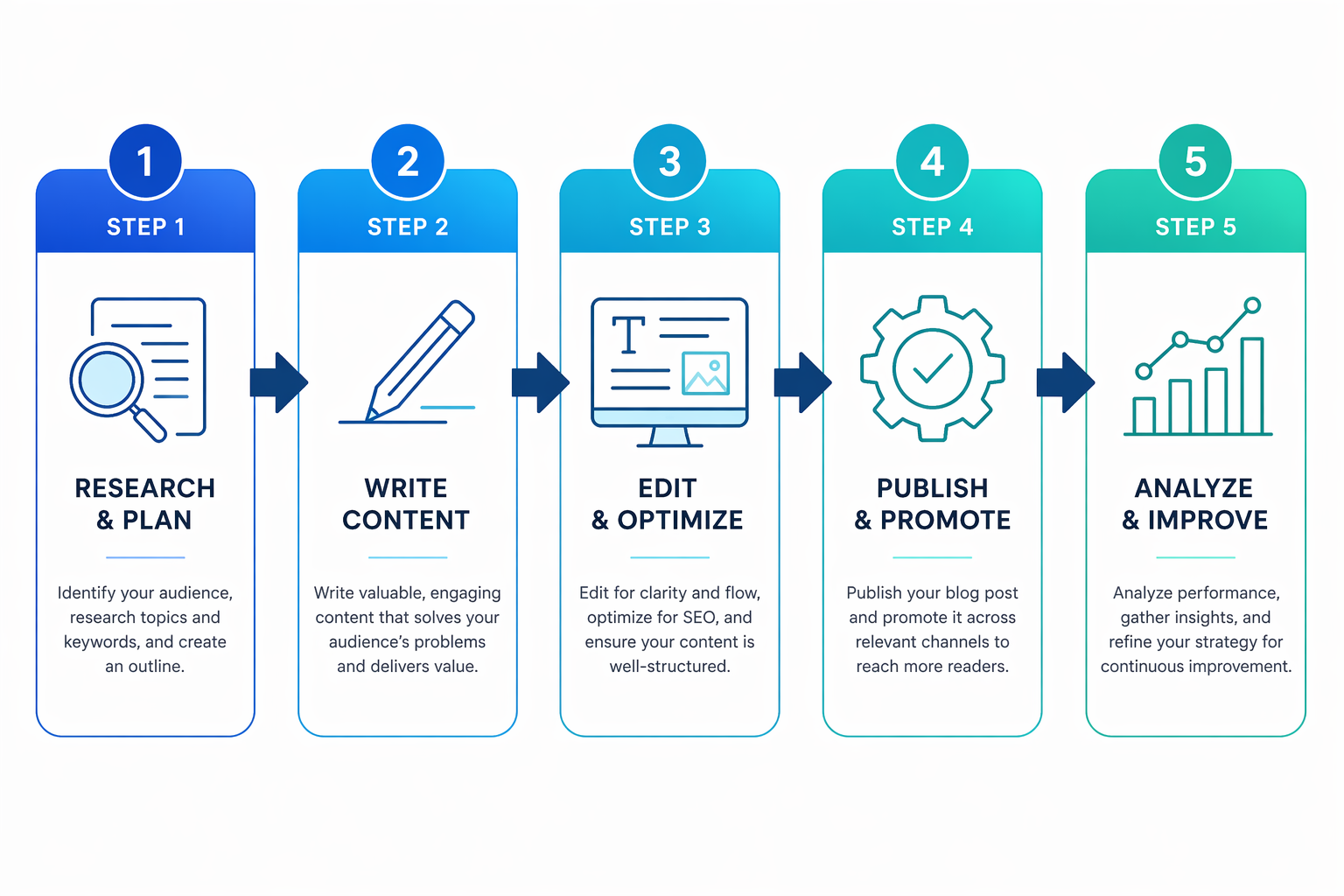
Run prompts in stages: outline, then draft, then edit. After each step, ask for one change at a time. This mirrors the iterative prompt refinement approach described on llmguides.ai, which stresses clear tasks, context, and constraints for better AI outputs.
Use these prompts in your next content brief, then visit our AI content generation pillar to build a full prompt workflow.

Plug your topics into SnowSEO, generate optimized blog drafts, then track rankings across search and AI platforms in one place.
Frequently Asked Questions
Q1: How often should I reuse these AI blog prompts?
Use them for every new blog idea. Reuse the same structures, but swap topics, keywords, and audience. Refresh prompts each quarter as search intent shifts. Treat them like templates, not scripts.
Q2: Which tools work best with these prompts?
They work well with ChatGPT or Claude. Pair them with an SEO keyword research tool and a content brief template. A platform like SnowSEO then helps you tie prompts back to keywords, audits, and rankings.
Q3: How do I keep AI blogs from sounding generic?
Add real examples, numbers, and internal data. Give the AI your brand voice rules. Add your own intro and conclusion. Use AI for first drafts, then edit like crazy.
Q4: Can these prompts support a full content calendar?
Yes, if you group prompts by funnel stage. Use intent research in SnowSEO or Surfer SEO, then map prompts to awareness, comparison, and decision posts. One prompt format can fuel many angles.
Conclusion
Strong AI prompts make blog writing faster, sharper, and far less painful. The best AI blog writing prompts are specific, not generic. Prompts should follow the blog workflow from angle selection to CTA creation. SEO results improve when prompts include search intent, keyword, and formatting instructions. Reusable prompt templates help teams scale blog production consistently.
Leave a Reply