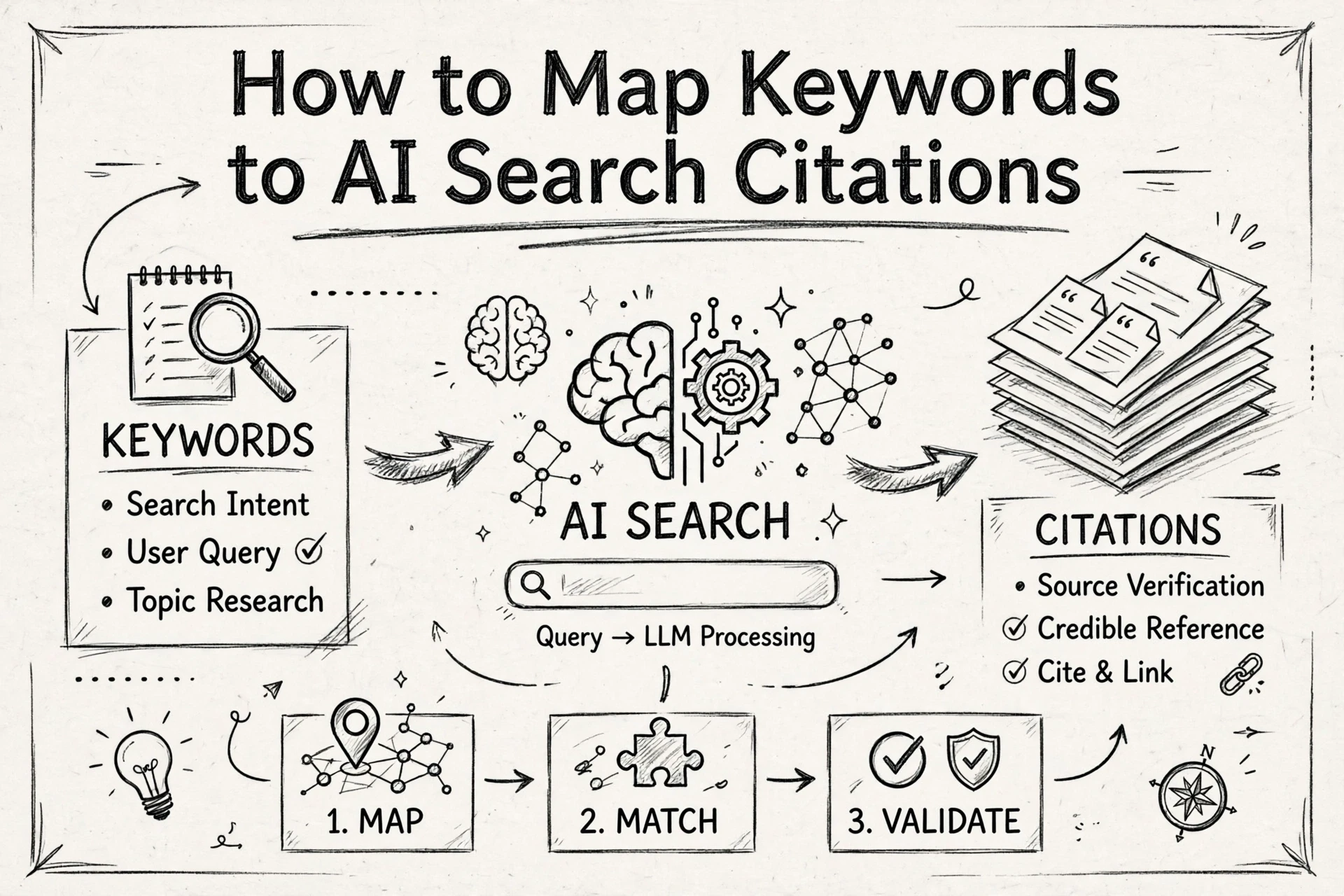
Quick Summary: Ranking first for a keyword no longer guarantees visibility in AI search, since engines like ChatGPT cite pages that directly answer comparison or problem-based queries. To win those citations, build 8-12 prompts from your target keyword, log the exact URLs and passages AI systems cite, then fix your page’s answer shape, evidence, and clarity. Re-test the same prompts every 2-4 weeks, prioritize gaps by business value, and remember that tables and stats boost citability by up to 47%.
Your page ranks #1 for “best project management software for small teams,” but ChatGPT cites three competitors. Why? Their passages answer the comparison question directly, so the AI can retrieve and quote them. Ranking alone tells you nothing about citability. This guide shows you how to map keywords to AI search citations: a repeatable workflow that turns what AI answers say into specific page and passage fixes you can apply today.
Step 1: Turn One Target Keyword Into a Citation Query Set
One keyword won’t tell you if AI engines cite you. AI engines rewrite each prompt into hidden sub-queries, so your keyword is just the starting point for a full set of prompts you can use to map keywords to AI search citations.
Define the Keyword’s Intended Answer
Write the one-sentence answer your page should earn a citation for. Ask: what decision does the searcher make after reading? A keyword like “email marketing pricing” has direct-answer intent; “best email tool for startups” has recommendation intent. Cited pages match the wording of the question closely, per citation mechanics research, so intent first, prompts second.
Build Prompts From the Same Intent
Turn the keyword into 8-12 prompts:
- The head question (“What is X?”)
- Comparison prompts (“X vs Y”)
- Problem prompts (“How do I fix X?”)
- Buyer prompts (“Best X for [audience]”)
AI engines fan one question out into several narrower sub-queries, so specific, narrow prompts mirror what engines actually retrieve, as query fan-out analysis shows.
Also Read: Keyword Research vs SEO Audits for Generative Search Success
Step 2: Record the URLs and Passages AI Systems Cite
Now capture what each answer actually references. Don’t just note that a competitor got cited – log the exact URL and the sentence the engine pulled from it.
Use a Citation Mapping Spreadsheet
Build a simple sheet with one row per citation:
| Column | What to Log |
|---|---|
| Prompt | The query you ran |
| Engine | ChatGPT, Perplexity, Gemini, etc. |
| Cited URL | Exact page cited |
| Passage | The quoted or paraphrased line |
| Date | When you ran the prompt |
Run every prompt on each engine twice. Citation counts vary hugely by engine, so one snapshot misleads. Tools like SnowSEO and Otterly.AI can automate the collection across engines and dates.

Classify the Competitor’s Citation Role
Look at why each page earned its slot:
- Definition source – the engine used it to explain the topic.
- Comparison source – it fed a “best X” or “vs” answer.
- Evidence source – it supplied a stat or case study.
This tells you which content type to build in Step 3.
Also Read: Ahrefs Keyword Explorer Review for AI Search Research
Step 3: Match Each Citation to a Page-Level Content Gap
Now compare your page against each competitor citation. AI engines pick passages, not pages, so the gap is usually one liftable answer, not a whole rewrite. Google’s own guidance says there is no special markup – it judges whether your passage can be lifted cleanly.
Compare Answer Shape, Evidence, and Clarity
Score the cited passage against yours on three things:
- Shape – does it state a direct answer in the first 40-60 words? Self-contained passages win.
- Evidence – does it name specific numbers or sources? Statistics add roughly 30% to AI visibility.
- Clarity – would the sentence still make sense pulled out of the page?
Choose an Edit That Improves the Source Passage
Pick one fix per gap and log it: add a stat, front-load the answer, or convert a paragraph into a table or list. Table-based pages earn 47% more citations, per citation research. SnowSEO audits flag these passage-level gaps automatically.
Also Read: Google AI Search Research Reveals New Keyword Opportunities
Step 4: Re-Test the Keyword Map and Prioritize the Citation Gap
Track Frequency, Stability, and Citation Role
Re-run your full prompt panel two to four weeks after publishing changes. Log three things for each keyword: how often your page gets cited, whether the citation holds across repeated runs, and what role it plays. Being the single source for a claim is worth far more than appearing in a link dump.
Keep the prompt set frozen. If you change the prompts, you change the baseline and lose your trend data.
Citations drift a lot – studies show 40-60% of cited domains shift month to month, so one snapshot tells you little.
Prioritize by Business Value
Score each gap before you fix it. Simple matrix:
| Gap | Effort | Business Value | Do First? |
|---|---|---|---|
| Easy fix, high-value page | Low | High | Yes |
| Hard fix, high-value page | High | High | Plan it |
| Easy fix, low-value page | Low | Low | Batch it |
Revenue-driving keywords and comparison prompts win. Tools like SnowSEO surface these gaps automatically, so you spend time writing, not sorting spreadsheets.
Ready to turn keyword research into AI citations? SnowSEO maps keywords to mentions across ChatGPT and Claude. Start your free trial today.
Frequently Asked Questions
Q1: How can teams connect keyword opportunities with citations in AI-generated answers?
Track which pages AI engines cite for your target terms, then map each citation back to its keyword cluster and update that page’s headings, passages, and schema to match.
Q2: How often should I re-check AI citations?
Weekly is enough for most sites. Re-check faster after publishing new content or when a competitor jumps into answers for your top terms.
Q3: Do I need a dedicated AI visibility tool?
You can check prompts manually, but tools like SnowSEO, Otterly.AI, or Peec AI automate tracking at scale and show citation trends over time.
Q4: Which pages earn AI citations most often?
Clear, well-structured pages: strong headings, direct answers in the first paragraphs, and specific data. Lists, tables, and definitions get cited more than long opinion pieces.
Conclusion
Mapping keywords to AI citations turns guesswork into a repeatable loop: run prompts, log who gets cited, fix the passages, retest. Research on 602 prompts shows cited pages share clear traits like modular structure and extractable evidence. Keep testing weekly.
Leave a Reply