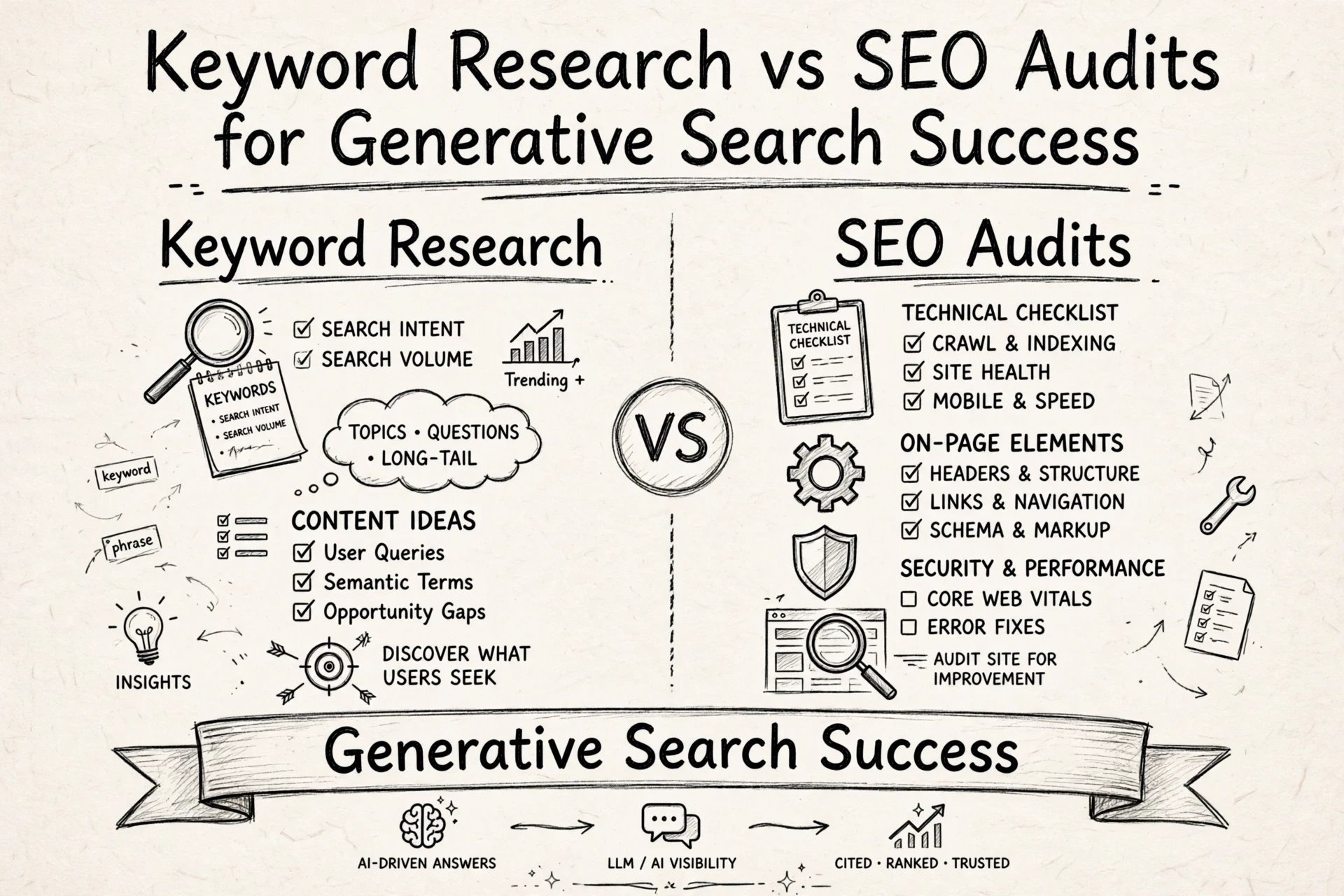
Quick Summary: Keyword research and SEO audits both matter for generative search, but the right starting point depends on your bottleneck. If your site is technically sound but traffic is flat, do keyword research first to find what buyers ask AI engines. If crawlers can’t access or parse your pages, run an audit first, since AI engines can’t cite content they can’t read. Most sites need both in sequence, and platforms like SnowSEO bundle them into one workflow.
Keyword research vs SEO audits: which comes first when AI engines answer buyers? Research finds the questions people ask. Audits make sure engines can crawl, read, and trust your pages. In keyword research vs SEO audits, the winner depends on your bottleneck – and most sites need both, in the right order.
Keyword Research vs SEO Audits for Generative Search
| Keyword research | SEO audits | |
|---|---|---|
| Primary purpose | Discover demand, topics, and search language | Find barriers to crawling, indexing, and understanding |
| Best question answered | What do people want to know or compare? | Can engines access and interpret what we publish? |
| Generative search contribution | Maps conversational prompts and content gaps | Improves accessibility, clarity, structure, and trust signals |
| Main deliverable | Prioritized keywords, questions, clusters, and briefs | Prioritized issues, fixes, and technical recommendations |
| When it should come first | When the site is healthy but content direction is unclear | When visibility is weak or the site has technical uncertainty |
How Keyword research and SEO audits Compare
Keyword research
Keyword research finds what people actually ask search engines and AI assistants. It’s for teams with a healthy site but unclear content direction. Its main deliverables are prioritized keywords, questions, topic clusters, and briefs – including the conversational prompts that drive generative search.
- Maps audience language and content gaps
- Surfaces questions people bring to AI assistants
- Clarifies what to create and compare
SEO audits
An SEO audit is a structured diagnosis of technical, on-page, and machine-readability issues. It suits teams whose visibility is weak or whose site has technical uncertainty. The output is a prioritized list of fixes that help engines crawl, index, and trust your content.
- Finds crawling, indexing, and clarity barriers
- Strengthens structure and trust signals
- Prioritizes fixes before content investment
What Keyword Research Contributes to Generative Search
Keyword research tells generative engines what demand exists. AI Overviews and ChatGPT break prompts into sub-questions and answer with cited sources, so research now maps questions and entities, not just volume.
From Keywords to Questions, Entities, and Scenarios
The unit of research has shifted. Instead of “best CRM,” you map the full prompt, the follow-up questions, and the entities a complete answer must name. This matters because engines activate entities, not keyword strings, when they build answers.
What a Generative Search Research Brief Should Contain
A brief built for AI citation includes:
- Seed prompts in full conversational language
- Fan-out sub-questions the engine will generate
- Entity map of products, concepts, and brands
- Citation targets showing which pages AI already quotes
Platforms like SnowSEO combine these into one workflow, so research feeds directly into content and rank tracking.
Also Read: SnowSEO – Your Last SEO Platform
What an SEO Audit Contributes to Generative Search
An SEO audit tells you whether AI engines can actually reach your site. If a crawler cannot fetch a page, it cannot cite it. That makes the audit the gatekeeper for everything else you do in GEO.
The Audit Checks That Matter Most for AI Discovery
Focus on the checks that decide whether AI bots can access and parse your pages:
- Check that robots.txt, firewalls, and bot rules allow retrieval bots like GPTBot, ClaudeBot, and PerplexityBot.
- Confirm key content sits in raw HTML, since many AI crawlers skip JavaScript.
- Validate schema markup, fix broken pages, and review server logs for AI bot errors.

Why Technical Health Still Supports GEO
Generative engines still build on core search systems. Google states its AI features rely on the same ranking and quality systems that power Search, so crawlability, clean structure, and helpful content remain the base. An audit finds the problems that quietly block AI visibility before you invest in content. Platforms like SnowSEO run these checks together so technical gaps and AI citations get tracked in one place.
Also Read: How to Optimize Content for Generative Engine Results
Which Should You Prioritize First?
Ask one question: what’s blocking results right now? If pages load slowly, Google skips key sections, or AI engines can’t parse your content, fix the site first. If the site is healthy but traffic is flat, you need better targets.
Choose an Audit First When the Site Is the Bottleneck
Run an audit before anything else when crawl errors, slow pages, or blocked content exist. Keyword research is pointless if AI engines and search crawlers can’t read what you publish. Platforms like SnowSEO bundle both, so you can audit and then research in one place.
Choose Research First When Content Direction Is the Bottleneck
Pick keyword research first when your site is technically sound but ranks for the wrong terms. Find what your buyers actually search and ask AI chatbots, then build pages around that demand. Tools such as Peec AI or Otterly.ai can show how AI engines mention your brand today.
Also Read: 10 Best Tools for Competitor SEO Analysis in 2024
Which Should You Choose for Generative Search Success?
Choose both – in order. Keyword research first, so you know what people ask AI engines. Then audits, to fix crawl and citation issues. Google confirms SEO basics still power AI Overviews, and Semrush notes AI visibility rides on that same foundation.
Stop guessing what AI engines see. SnowSEO handles keyword research and audits in one place. Start free today.
Frequently Asked Questions
Q1: Keyword research vs traditional SEO audits: what matters most for generative engine optimization success?
Both matter, but in order: research first to find demand, then audits to confirm your content is technically and structurally ready.
Q2: Should I run an audit before doing keyword research?
No. Research shows what to target. Audits work better when they check readiness for those targets.
Q3: How often should I combine both?
Revisit research quarterly, audit monthly. Platforms like SnowSEO automate both in one workflow.
Conclusion
Keyword research finds what people ask. SEO audits prove AI engines can read and cite your answers. Do research first when demand is unclear, audit first when rankings exist but AI citations don’t. Winning generative search needs both, working together. As Search Engine Land notes, getting cited by AI engines is now the goal, and HubSpot confirms GEO builds on proven SEO principles rather than replacing them.
Leave a Reply