Tag: Tools

  • Rank Tracking Setup for Google and AI Search

    Rank Tracking Setup for Google and AI Search

    Quick Summary: Effective rank tracking now combines Google search positions with AI visibility metrics like citations and mentions. Building a keyword set focused on buyer intent and splitting content types helps monitor both search worlds. Regularly reviewing AI citations, adjusting prompts, and tracking metrics like mentions and citations improve understanding of brand presence across AI and traditional search platforms.

    If your client sits at #3 for a money term in Google but stays invisible in ChatGPT, Perplexity, and AI Overviews, your Rank Tracking misses half the market. That is the gap this guide fixes. You will build a simple Rank Tracking system that joins Google data with AI visibility, prompt coverage, and reporting. I work with teams that already use SEO Rank Tools and need cleaner AI Search Optimization. Good Rank Tracking now means tracking both search worlds together.

    Step 1: Build a keyword set that works for both Google and AI search

    Start with buyer-intent prompts, not just broad terms. Google says its systems match both words and concepts, and AI search still sits on core search systems, so natural questions matter as much as short keywords according to Google and its 2026 AI search guidance here. Build lists like:

    • “best crm for small law firm”
    • “shopify seo app comparison”
    • “how to switch from agency to in-house seo”
    Flowchart with grouped keyword prompts on a workspace desk
    Flowchart with grouped keyword prompts on a workspace desk

    Split the set into clear page types:

    • Money pages – product, service, category, demo, pricing
    • Support content – how-to, setup, use case, troubleshooting
    • Comparison queries – best, vs, alternatives, reviews

    Do not track every variation. Track the main query, close variants, and the prompt-style version.

    Also Read: Best SEO Tools: 25 Picks to Improve Rankings in 2026

    Step 2: Configure Google rankings and AI surfaces in one tracking view

    Start with Google organic as your control layer. Track:

    1. Primary keyword rank
    2. SERP feature presence like featured snippets, People Also Ask, local pack, and video
    3. Device and location splits

    Google now blends AI Overviews and AI Mode more tightly into Search, so your baseline report needs both classic rank and feature ownership, not just blue-link position, per Google’s 2026 Search update.

    Then add AI surfaces as a second view for the same keyword set:

    • AI Overview present or not
    • Brand cited or not
    • Competitor cited or not
    • ChatGPT, Claude, Perplexity, and Gemini mention share

    Keep one row per keyword and add columns for each engine. That makes gaps obvious fast.

    Keyword Google Rank AI Overview ChatGPT Perplexity Gemini
    running shoes flat feet 4 cited not cited cited cited

    Google’s AI answers appeared in 43% of searches by mid-2026, according to TechCrunch citing Similarweb.

    Also Read: 10 New Keyword Research Techniques to Try Now

    Step 3: Standardize your metrics so reporting stays clean

    Use average position and share of top 3 or top 10 for Google. Keep those separate from AI search. Google itself says AI Overviews show an AI snapshot with links to dig deeper, so track mentions, linked citations, and citation rate instead of forcing a rank model onto AI results (Google Search Help). That keeps reports honest.

    Channel Core metric Good use
    Google Search Position Rank trend
    AI Search Mentions Brand visibility
    AI Search Citations Source inclusion
    Comparison dashboard with charts and data visualizations
    Comparison dashboard with charts and data visualizations

    Build one simple template your team uses every week:

    1. Google – average position, clicks, landing page.
    2. AI – prompt, mention yes or no, citation yes or no.
    3. Outcome – traffic, leads, revenue.

    Also Read: 10 Organic Growth Strategies to Drive Traffic in 2025

    Step 4: Set your tracking cadence, alerts, and review process

    1. Pick a cadence that matches volatility. Track core money terms daily. Check mid-tier keywords and AI prompts weekly. Review low-risk long-tail sets monthly. Google says it regularly improves ranking systems, so fixed monthly reviews alone miss useful shifts. Set alerts for sharp drops, new AI citations, and page swaps.

    2. Review competitors and refresh the prompt set regularly. Check which rival pages, entities, and answer formats now appear. Update prompts every month so they match real buyer questions. Google’s Generative AI performance report tracks impressions over time by page, device, and country, which helps flag drift fast.

    Homepage
    Homepage

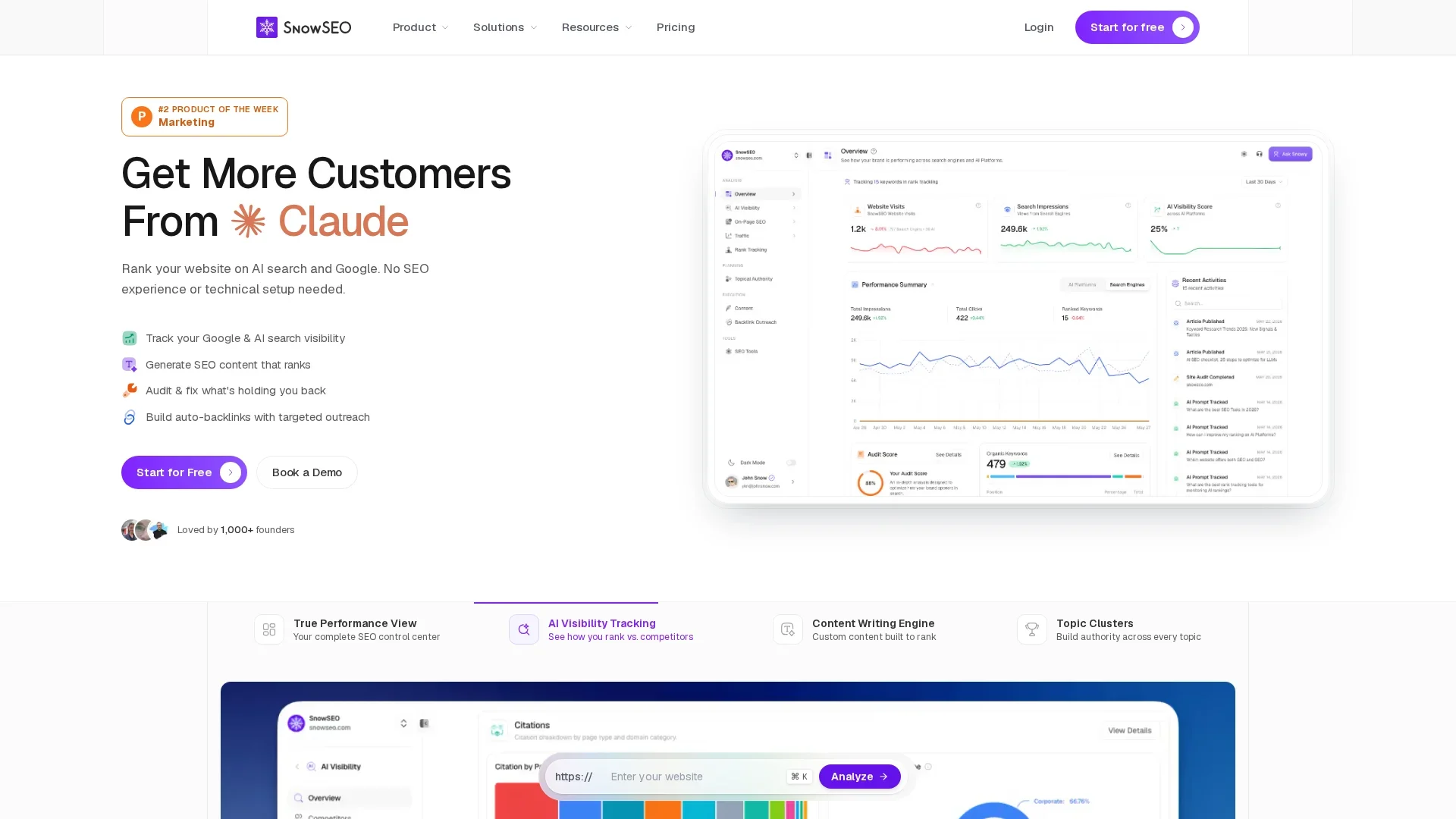
    If you want one workflow for Google rankings and AI visibility, try SnowSEO. Track positions, spot gaps, and turn reports into action faster.

    Frequently Asked Questions

    Q1: What are the essential steps to set up comprehensive rank tracking for Google and AI platforms?

    Track target keywords, prompts, pages, and brand mentions. Split branded and non-branded terms. Set a weekly pull, device and location rules, and one reporting view for rankings, AI citations, traffic, and conversions.

    Q2: How can businesses monitor brand citations in AI-generated results across ChatGPT, Claude, and Perplexity?

    Save a fixed prompt set by topic, intent, and funnel stage. Check whether your brand appears, where it appears, which source gets cited, and whether the answer is accurate. Log changes over time to spot wins and losses.

    Q3: What tools and metrics are best for tracking AI overview visibility and traditional search rankings?

    Use one system that tracks Google positions plus AI answer mentions. Key metrics include rank, share of voice, citation rate, AI overview presence, landing page, traffic, and assisted conversions. SnowSEO helps keep those signals in one workflow.

    Conclusion

    Track Google rankings and AI search visibility in one system, not two. Google says AI features rely on core ranking systems and can show mistakes, so your reporting should pair classic rankings with AI presence and page-level impact Google ranking systems guide AI Overviews help.

  • AI SEO Process Guide for Planning, Writing, and Review

    AI SEO Process Guide for Planning, Writing, and Review

    Quick Summary: Effective AI SEO requires a clear strategy before using AI tools, including defining goals, audience, and intent. Creating detailed briefs and human editing are essential to ensure quality, accuracy, and originality. Content should be regularly reviewed and updated to maintain rankings, with a focus on helping people first rather than just optimizing for search engines.

    If your team uses AI to draft posts from a keyword list but still rewrites every piece, the real issue is often the process. Most teams lack a clear SEO Content Strategy that connects briefs, drafting, review, and updates. This guide shows how to build that SEO Content Strategy, use a Keyword Research Platform, and apply AI Optimization Tools without breaking quality. It is built for teams that need a repeatable SEO Content Strategy that scales and still meets SEO standards.

    1. Build the Strategy Before You Use AI

    Set the plan first. AI should speed up work, not choose what you publish. Google says strong content starts with a clear audience and a real purpose, not pages made mainly to pull search traffic, according to Google’s people-first content guidance.

    • Define the business goal: traffic, leads, sales, or support
    • Name the reader: beginner, buyer, customer, or partner
    • Match each page to one intent: learn, compare, or buy
    Team planning a content strategy with flowchart and dashboards
    Team planning a content strategy with flowchart and dashboards

    Map topics next. Use a keyword platform to group terms by intent, not just volume. Good research shows what people ask, why they ask it, and which page should answer it, as explained in this 2026 keyword research guide.

    If AI writes before strategy is set, teams usually publish fast and miss the right topic.

    Also Read: 10 Organic Growth Strategies to Drive Traffic in 2025

    2. Create a Brief AI Can Actually Follow

    A good AI brief acts like a spec, not a loose idea. NIST’s 2026 GenAI challenge even treats prompters as a real role because prompt quality shapes output quality and believability in its evaluation design.

    • Include the essentials in every brief:
      • Goal
      • Audience
      • Search intent
      • Primary points to cover
      • Format
      • Tone
      • Must-use facts
      • Must-avoid claims

    If any of those are missing, the draft gets vague fast.

    Content strategist reviewing AI article brief with SERP notes
    Content strategist reviewing AI article brief with SERP notes

    Add examples, constraints, and source rules. Harvard’s prompt guidance says specific prompts, examples, and clear “do” and “don’t” instructions improve output quality for text-based generative AI tools.

    Give AI one strong sample paragraph, one bad example, and clear review rules.

    1. Define what good looks like.
    2. Set hard limits.
    3. List trusted references.

    Also Read: 10 Best Tools for Competitor SEO Analysis in 2024

    3. Write, Optimize, and Human-Edit the Draft

    Use AI to build the outline, key points, and first draft fast. That saves time, but it does not remove editorial work. Google says content should help people first, not exist mainly to game rankings, so treat AI as a drafting tool, not the author of record Google’s people-first content guidance.

    Edit next for facts, overlap, and brand voice. Cut filler. Add real examples, sharp claims, and clear source checks. Google’s rater guide also flags pages with little effort, low originality, or little added value, which is exactly what unchecked AI drafts often become Google’s Search Quality Rater overview.

    Optimize last, not first. Tighten headings, internal links, entity mentions, and search intent match. Then check if the page answers the query better than what already ranks. Tools like SnowSEO can speed up brief-to-draft checks, but a human should still approve accuracy, tone, and final publish readiness.

    Also Read: 10 New Keyword Research Techniques to Try Now

    4. Review, Publish, and Refresh the Content

    Use a simple publish-ready checklist

    Check the page before it goes live. Confirm search intent, facts, links, headings, schema, and on-page UX. Google says people-first content should be helpful, accurate, and clearly trustworthy in its content quality guidance.

    Publish only when the page feels complete, not just finished.

    Plan updates before rankings fade

    Set a refresh date when you publish. Review performance, query shifts, CTR, and outdated claims every 60 to 90 days. Google advises waiting at least a week after a core update ends before comparing performance in Search Console, per its core updates guidance.

    Homepage
    Homepage

    Ready to turn your AI SEO process into a repeatable system? Use SnowSEO to plan, write, audit, track, and improve content faster.

    Frequently Asked Questions

    Q1: What are the best strategies for planning an effective AI-driven SEO content workflow?

    Set clear briefs, search intent, owners, and review steps. Map topics first.

    Q2: How can I optimize AI-generated content for search engines and AI platform mentions?

    Edit for facts, structure, entity clarity, and original insight. Add useful examples.

    Q3: What human editing practices ensure AI SEO content ranks well and maintains quality?

    Check accuracy, remove filler, fix tone, and improve headings, links, and trust signals.

    Conclusion

    AI SEO works best as one shared process. Plan with search intent, write for people, review with standards, and improve often. Google says SEO still matters for generative AI search, while content quality matters more than production method.