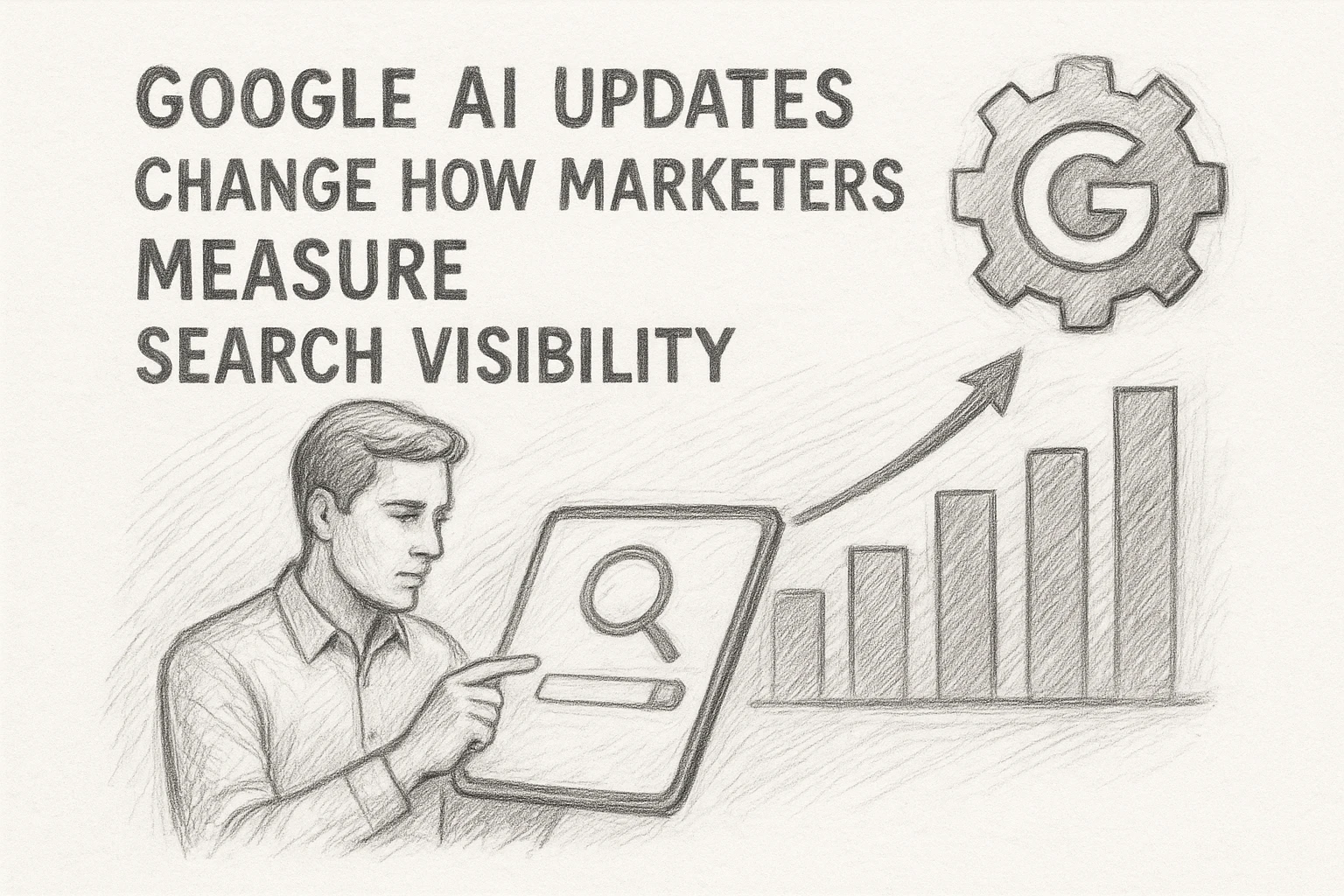
Quick Summary: Google now reports AI Overviews and AI Mode impressions separately in Search Console, so marketers must track AI visibility as exposure, not ranking. Treat these impressions as a leading signal and validate them with clicks, conversions, and revenue, since position alone no longer guarantees visibility. Google says existing SEO still matters, with no special AI-only rules, so keep focusing on crawlability, helpful content, and structured data. Track trends monthly and compare AI-visible pages against business outcomes to avoid mistaking presence for profit.
Google AI updates search visibility by folding AI Overviews and AI Mode links into Search Console Web data. New site-owner insights now show AI-feature impressions and page appearances. Google also offers an AI opt-out, but that removes related traffic.
Google AI updates search visibility beyond rank reports. A cited page may gain exposure without clicks. This guide explains what the data shows, what it cannot prove, and how to connect Search Console, analytics, and revenue.
Google’s New AI Search Data Changes the Visibility Baseline
What Google Now Counts as AI Visibility
Google AI updates search visibility by separating generative exposure from the old blue-link baseline. Search Console’s new reports count how often your URLs appear in AI Overviews, AI Mode, and generative Discover features. They also break exposure down by page, country, device, and date, as Google’s 2026 announcement explains.

| Old baseline | New baseline |
|---|---|
| Overall Web impressions | Generative AI feature impressions |
| Clicks and average position | Appearing URLs, country, device, and time |
| Rank-focused reporting | Visibility plus visit quality |
Do not treat an AI mention as a ranking. Measure it as exposure, then compare clicks, leads, and sales by landing page.
Google AI updates search visibility, but generative data is rolling out first to a subset of sites.
Also Read: Google and AI Platforms Shift Guidance for Generative Search Visibility
The Metrics Marketers Have, and the Ones They Still Need
A Four-Layer Reporting Model
Google now separates AI feature impressions for AI Overviews and AI Mode by page, country, device, and date in Search Console’s Generative AI report. Build reporting around four layers:
- Presence: AI impressions by page and market.
- Organic demand: Total Search Console impressions, clicks, and average position.
- Site value: Sessions, engaged sessions, leads, sales, and revenue in analytics.
- Business impact: Assisted conversions, repeat visits, and branded search growth.

| Layer | What you can measure | What is still missing |
|---|---|---|
| AI presence | Impressions, pages, countries, devices | Queries, clicks, CTR, citation position |
| Organic search | Clicks, impressions, rankings | Clear AI feature attribution |
| Outcomes | Conversions and revenue | Direct AI-assisted conversion path |
Treat AI impressions as a leading signal, not proof of traffic or sales. Google says it is still exploring further reporting insights in its 2026 announcement.
- Review trends monthly, not daily.
- Compare AI-visible pages with conversion data.
- Flag pages that gain presence but lose organic clicks.
Also Read: SnowSEO – Your Last SEO Platform
Google’s AI Results Make Ranking Reports Less Complete
Why Position Is No Longer the Whole Story
A rank of #1 no longer guarantees the most visible spot. AI Overviews and AI Mode can place answers, links, and follow-up paths above or around classic results. Google also uses query fan-out, which can pull in pages that do not rank for the exact search term, according to Google’s AI features guide.
Track more than position:
| Signal | What it tells you |
|---|---|
| Classic rank | Your placement in blue-link results |
| AI impressions | How often your pages appear in AI features |
| Clicks and leads | Whether visibility creates business value |
Google’s new AI report separates impressions by page, country, device, and date, but it does not yet show every reason a page was selected. Google’s announcement confirms the shift.
Treat rankings as a useful clue, not your full visibility score.
- Check pages cited in AI results.
- Compare AI impressions with clicks and conversions.
- Review trends weekly, not one keyword at a time.
Also Read: GEO Optimization vs Traditional SEO: Which Drives AI Visibility?
Why Google Says Existing SEO Still Matters
Google’s AI features draw from its existing Search index and core ranking systems, so solid SEO remains the entry point. Google’s guidance says there are no separate AI-only rules to chase.
Keep doing the work that makes pages easy to find and trust:
- Allow crawling and indexing.
- Build clear internal links.
- Publish helpful, first-hand content.
- Match structured data to visible page text.
Do not spend your budget on special AI files or forced content chunks. Google says they are not required for AI Overviews or AI Mode.
Track the signals that matter. Use SnowSEO to audit visibility, monitor rankings, and spot search changes before traffic drops.
Frequently Asked Questions
Q1: What do Google’s latest AI announcements mean for organic search visibility?
AI answers can reduce clicks while still showing your brand. Track impressions, citations, branded searches, and assisted conversions, not rankings alone.
Q2: Should I stop tracking keyword rankings?
No. Keep rankings, but group them with click-through rate and page conversions. A top position matters less if AI results answer the query first.
Q3: Which pages should I review first?
Start with high-impression pages losing clicks. Check whether the query now triggers AI results, then add direct answers, proof, and clear next steps.
Conclusion
Measure AI visibility separately from traffic and revenue. Google now reports AI-feature impressions by page, country, and device in Search Console. Treat them as a signal, then validate business impact with conversions.