Tag: Artificial Intelligence

  • GEO Optimization vs Traditional SEO: Which Drives AI Visibility?

    GEO Optimization vs Traditional SEO: Which Drives AI Visibility?

    Quick Summary: GEO optimization and traditional SEO serve different goals: SEO drives rankings and clicks, while GEO earns mentions and citations in AI answers. They share the same foundations, so treat GEO as an added measurement layer, not a replacement. Start with solid SEO basics, then add GEO to track AI visibility and influence AI-led research. Use SEO data for traffic trends and GEO data for answer presence, and measure both separately.

    A top Google result may still miss a ChatGPT recommendation. GEO versus traditional SEO answers two different needs: search rankings and AI mentions. GEO versus traditional SEO is not a full reset. SEO builds findability, while GEO tracks AI retrieval and citations. This guide compares GEO versus traditional SEO so teams can use both with clear goals.

    GEO Optimization vs Traditional SEO: At a Glance

    Traditional SEO GEO optimization
    Primary visibility surface Ranked search results AI answers and generative search features
    Success metric Rankings, impressions, CTR, clicks, and conversions Mentions, citations, share of voice, sentiment, and AI referrals
    Content objective Satisfy search intent and earn clicks Provide clear, trustworthy, extractable answers
    Core authority signals Helpful content, links, technical quality, and expertise SEO foundations, entity clarity, corroboration, and source quality
    Best use case Sustainable organic traffic and discoverability Influence during AI-led discovery and evaluation

    How Traditional SEO and GEO optimization Compare

    Traditional SEO

    Traditional SEO improves visibility in ranked search results and earns qualified organic clicks. It suits teams focused on lasting traffic, using helpful content, links, technical health, and expertise to drive rankings, CTR, and conversions.

    GEO optimization

    GEO optimization helps brands appear in AI answers through mentions, citations, and recommendations. It suits teams shaping AI-led research and evaluation with clear, trustworthy, easy-to-extract answers. Google says SEO foundations still support generative search visibility.

    What Is the Difference Between GEO and Traditional SEO?

    Different Outputs, Shared Foundations

    Traditional SEO aims to earn rankings and clicks in search results. GEO aims to make your brand useful enough to appear in AI-generated answers, citations, and recommendations across AI platforms.

    The overlap is large: clear site structure, trusted sources, helpful pages, and strong technical health matter to both. Google says its AI features still rely on core Search ranking and quality systems, so SEO basics remain essential for Google visibility. Google’s guidance confirms this.

    Key insight: Treat GEO as an added measurement layer, not a replacement for SEO.

    • SEO tracks: rankings, organic visits, conversions
    • GEO tracks: brand mentions, citations, answer coverage

    Also Read: 10 Must-Have Tools to Streamline Your SEO in 2025

    How Content and Technical Strategy Change

    What to Keep From SEO

    Keep the basics: crawlable pages, clear internal links, fast mobile pages, and useful content. Google says AI features use the same core search foundations, with no extra technical requirements for eligible pages. Google’s guidance supports this approach.

    • Keep key facts in visible page text.
    • Match structured data to on-page content.
    • Build topic clusters around real user needs.

    SEO specialist mapping topic clusters with product team
    SEO specialist mapping topic clusters with product team

    What GEO Adds

    GEO changes the content brief, not the foundation. Write direct answers, show first-hand proof, and cover related questions AI systems may explore. Track citations, brand mentions, and referral conversions across AI platforms.

    SEO focus GEO addition
    Rank for queries Earn citations in answers
    Build topical pages Add clear, quotable facts
    Track organic clicks Track AI mentions and outcomes

    Also Read: 10 Best Tools for Competitor SEO Analysis in 2024

    How to Measure Visibility and Choose the Right Workflow

    Metrics That Should Not Be Confused

    Track Google clicks, impressions, CTR, and position separately from AI answer mentions, citation rate, and share of voice. Google defines CTR as clicks divided by impressions in Search Console.

    Clean split chart comparing clicks to AI citations
    Clean split chart comparing clicks to AI citations

    A high AI mention rate does not guarantee visits or sales.

    What to Look for in a GEO Tool

    Choose a tool that:

    • Tests priority prompts across AI platforms
    • Records brand mentions and cited URLs
    • Compares competitors
    • Links findings to content tasks and business results

    Use SEO data for traffic trends and GEO data for answer presence. SnowSEO can unite audits, rank tracking, and AI visibility work in one workflow.

    Also Read: 7 GEO Optimization Tools for Brand Visibility in AI Answers

    Which Should You Choose: GEO or Traditional SEO?

    Choose traditional SEO first, then add GEO where AI answers shape your buyers’ research. Google says its AI features still rely on core ranking and quality systems, so strong SEO remains the base for visibility in AI search.

    If your goal is Prioritize
    Earn rankings, traffic, and sales Traditional SEO
    Track brand mentions in AI answers GEO
    Build durable visibility across both SEO plus GEO

    Do not treat GEO as a replacement for technical health, useful content, and authority. Start with the basics, then monitor AI visibility.
    Homepage
    Homepage

    Build SEO and GEO in one workflow. Use SnowSEO to audit, track, and improve AI visibility.

    Frequently Asked Questions

    Q1: How does GEO optimization compare with traditional SEO for visibility in AI-generated answers?

    GEO helps AI systems find, trust, and cite your content. Traditional SEO builds ranking strength. Use both to earn traffic and AI answer visibility.

    Q2: Should I replace SEO with GEO?

    No. Strong technical SEO, useful pages, and authority still support AI visibility.

    Q3: What should I measure?

    Track AI mentions, citations, search rankings, qualified visits, and conversions.

    Conclusion

    Traditional SEO builds the foundation. GEO expands visibility across AI answers. Google confirms strong SEO still supports AI features, so measure both visibility and business results.
  • SnowSEO vs Semrush for AI Search Visibility Tracking

    SnowSEO vs Semrush for AI Search Visibility Tracking

    Quick Summary: Your Google rankings don’t matter if AI tools like ChatGPT ignore your brand-so SnowSEO bundles AI visibility tracking (mentions, citations, sentiment) directly into its SEO workflow, making it ideal for lean teams that need actionable insights without switching tools. Semrush, meanwhile, excels at deep AI prompt tracking across platforms (ChatGPT, Gemini) and competitor benchmarking, but its $99/month AI plan and sprawling suite suit larger teams already using its tools. The key difference: SnowSEO ties visibility data to audits and content tasks in one place, while Semrush delivers broader market context for teams prioritizing research over execution.

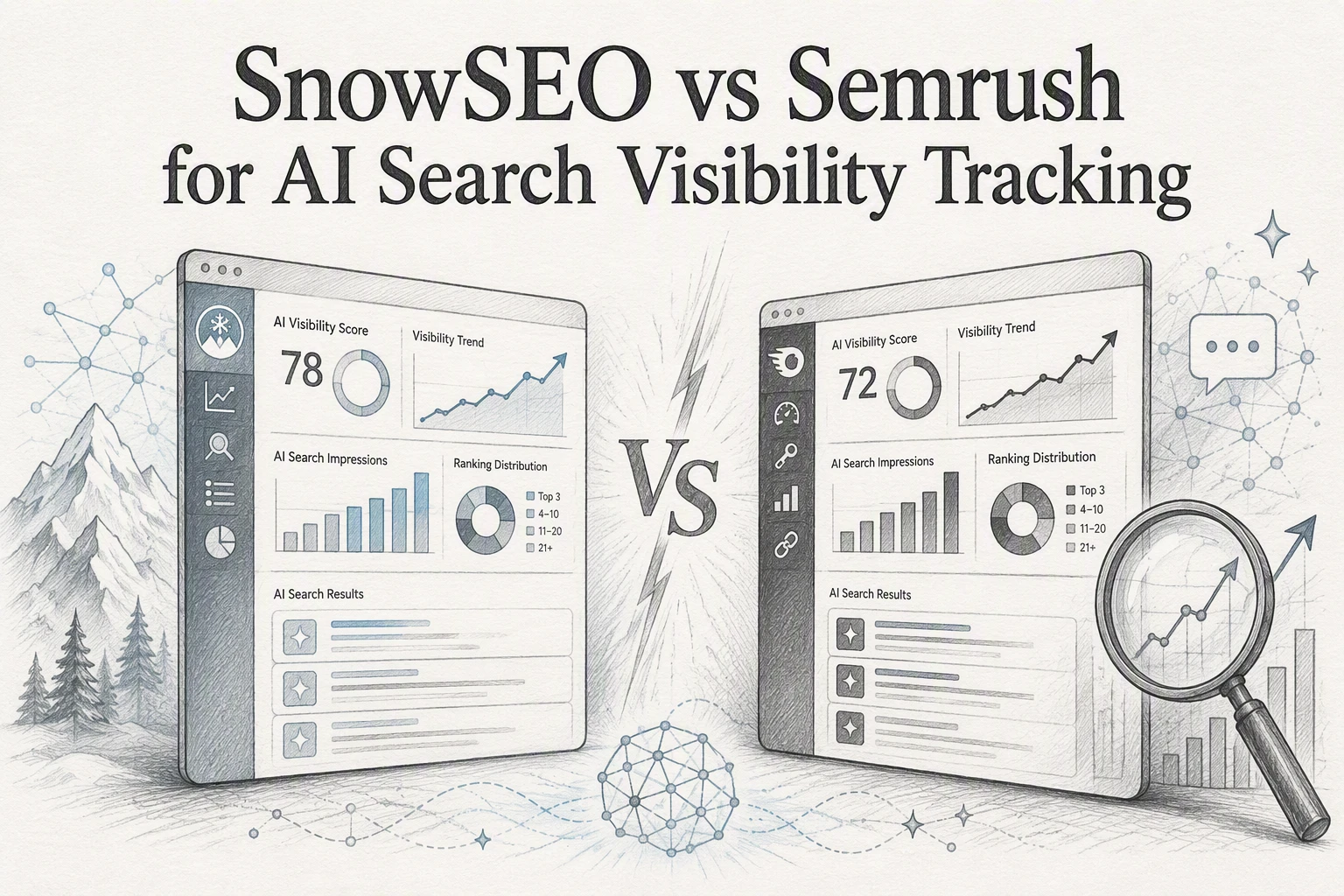
    Strong Google rankings mean little if ChatGPT or Gemini never mentions your brand. This AI search visibility tracking comparison tests SnowSEO and Semrush on AI mentions, citations, competitor gaps, and action steps. SnowSEO suits lean teams needing one workflow. Semrush fits teams using its wider SEO suite and AI Visibility Toolkit. This AI search visibility tracking comparison focuses on data you can use.

    SnowSEO vs Semrush: AI Visibility Tracking at a Glance

    SnowSEO Semrush AI Visibility Toolkit
    Primary tracking model Google keywords plus AI prompts and brand visibility AI prompts, brand visibility reports, and traditional Position Tracking
    AI visibility signals Mentions, citations, sentiment, share of voice, visibility score Visibility score, mentions, citations, cited pages, sentiment, average position
    Traditional rank tracking Daily keyword tracking with GSC and live SERP data Mature daily position tracking across locations and devices
    Competitive analysis Competitor visibility, SOV, citations, and ranking comparisons Competitor visibility, prompt gaps, cited sources, and benchmarks
    Optimization workflow Keywords, clusters, content, audits, outreach, and publishing Research, audits, reporting, and connected Semrush toolkits
    Best fit Lean teams, SMBs, agencies seeking an integrated workflow Existing Semrush users, larger SEO teams, and agencies needing depth

    How SnowSEO and Semrush AI Visibility Toolkit Compare

    SnowSEO

    SnowSEO unifies Google rank tracking with AI prompt, brand, and competitor visibility in one SEO and GEO workflow. It suits lean teams, SMBs, and agencies that need data tied to content, audits, outreach, and publishing in this AI search visibility tracking comparison.
    SnowSEO

    Semrush AI Visibility Toolkit

    Semrush adds AI prompt tracking, citations, sentiment, and competitor research to its established SEO suite. It fits existing Semrush users and larger teams needing depth, with daily prompt tracking across key AI platforms.
    Semrush AI Visibility Toolkit

    What Each Platform Actually Tracks

    From Keyword Positions to AI Answer Presence

    Traditional rank tracking measures where a page sits in search results. AI tracking asks whether your brand, page, or citation appears inside an answer.

    Platform What it tracks
    SnowSEO Keyword ranks, AI platform visibility, citations, audits, and competitor gaps
    Semrush AI mentions, cited pages, prompt visibility, sentiment, and average citation position

    Semrush tracks prompts across ChatGPT, Google AI Mode, and Gemini, including daily changes and cited domains, as its Prompt Tracking guide explains.

    Tip: Track citations and mentions separately. A brand mention builds awareness; a cited page shows content AI systems use.

    Also Read: 10 Organic Growth Strategies to Drive Traffic in 2025

    Coverage, Competitor Insights, and Reporting Compared

    Which Tool Gives More Actionable Competitive Context?

    Semrush offers broader AI coverage and clear competitor benchmarks. Its reports compare mentions, citations, audience, and prompt gaps across major AI platforms. You can add up to four rivals, then find prompts where they appear and you do not, as outlined in Semrush’s competitor report.

    Competitor gap analysis dashboards side by side
    Competitor gap analysis dashboards side by side

    SnowSEO is the better fit when your team needs those gaps tied to execution in one workspace.

    Need Better fit
    Cross-platform benchmark reporting Semrush
    Audit, content, tracking, and competitor work together SnowSEO

    Track prompt gaps, cited pages, and competitor mentions. A visibility score alone does not tell your team what to fix.

    • Use Semrush for wide market reporting.
    • Use SnowSEO to turn findings into SEO tasks.

    Also Read: 10 Best Tools for Competitor SEO Analysis in 2024

    Workflow and Value: Tracking Data That Leads to Action

    Cost and Workflow Fit Matter More Than Feature Count

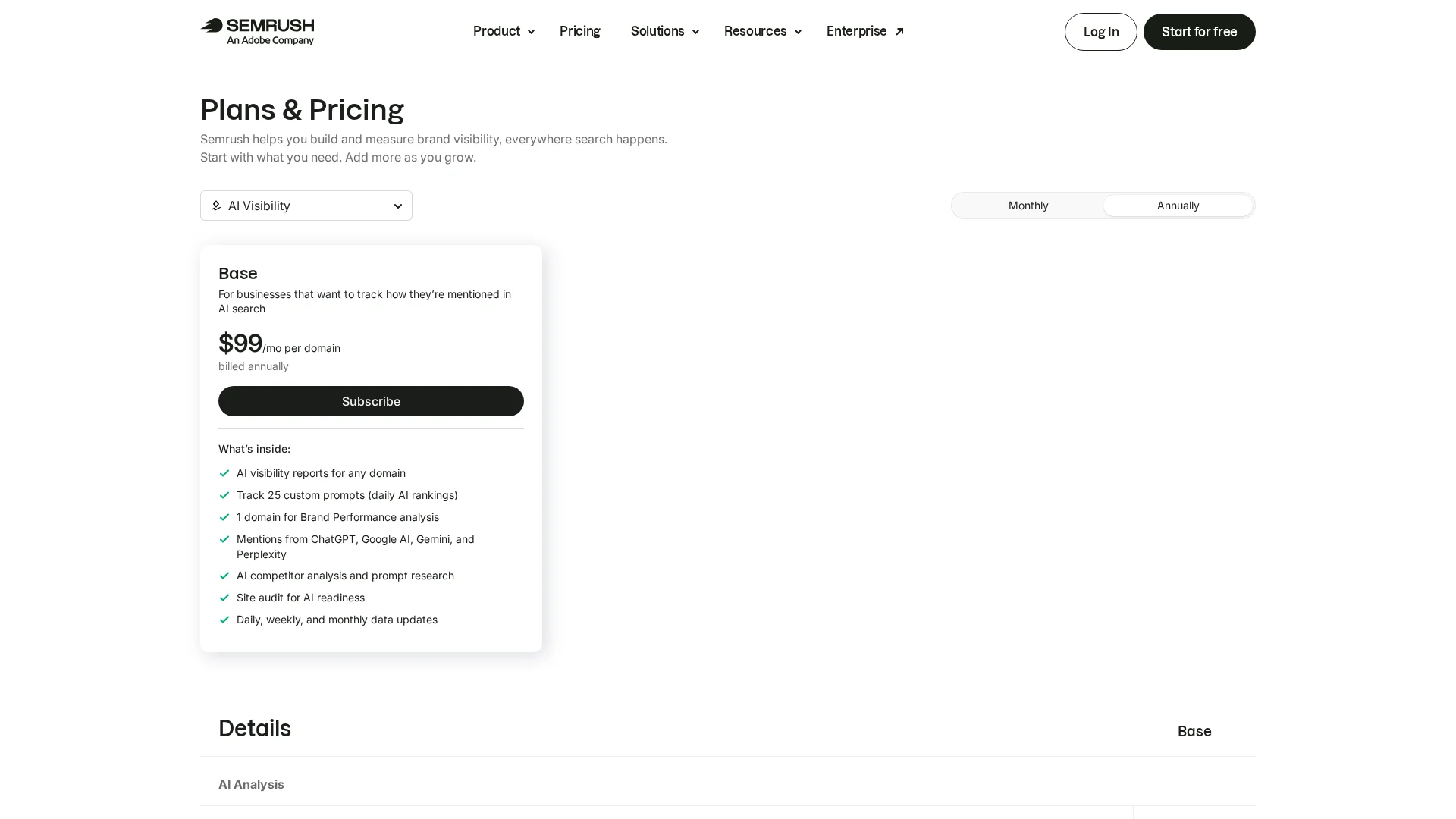
    Pick the tool that turns a visibility drop into a clear task. Semrush tracks daily prompts, competitors, citations, and AI search issues, but its AI Visibility plan starts at $99 per domain per month. It fits teams already using its wider SEO stack.

    Workflow need Better fit
    One place for audits, content, rankings, and AI visibility SnowSEO
    Deep AI prompt research alongside a large SEO suite Semrush
    Workflow clarity over feature depth
    Workflow clarity over feature depth
    • Find prompts where competitors earn citations.
    • Update the matching page or build a new answer.
    • Recheck mentions and cited URLs weekly.

    Track fewer high-value prompts first. More data is useless without an owner and a next step.

    Also Read: 7 Rank Trackers for Google, ChatGPT, and Claude Visibility

    Which Should You Choose: SnowSEO or Semrush?

    Choose SnowSEO if you need AI visibility tracking tied to audits, content, keyword work, and action in one workflow. Choose Semrush if your team already relies on its broad SEO suite and needs deep prompt-level benchmarking. Semrush tracks visibility across ChatGPT, Gemini, and Google AI Mode, including daily prompt changes in its AI Visibility Toolkit.

    Pick the platform your team will use to fix gaps, not just report them.

    Homepage
    Homepage

    Turn AI visibility data into clear actions. Track rankings, audits, and content gaps with SnowSEO.

    Frequently Asked Questions

    Q1: How does SnowSEO’s rank tracking feature compare to Ahrefs and SEMrush in AI search visibility?

    SnowSEO focuses on AI platform visibility alongside search tracking. Semrush and Ahrefs remain strong for classic rankings, while SnowSEO ties AI mentions to audits, content work, and next actions.

    Q2: Can I track ChatGPT visibility by keyword?

    Yes. Track prompts that reflect buyer questions, product terms, and category needs. Review brand mentions, cited sources, and competitor presence over time.

    Q3: Which metrics should agencies report first?

    Report AI mention rate, prompt coverage, share versus competitors, source citations, and change over time. Pair each metric with a clear content or technical action.

    Conclusion

    Choose SnowSEO for metric-led action in one workflow. Choose Semrush for broad prompt benchmarking, which tracks daily AI visibility.

  • AI SEO Process Guide for Planning, Writing, and Review

    AI SEO Process Guide for Planning, Writing, and Review

    Quick Summary: Effective AI SEO requires a clear strategy before using AI tools, including defining goals, audience, and intent. Creating detailed briefs and human editing are essential to ensure quality, accuracy, and originality. Content should be regularly reviewed and updated to maintain rankings, with a focus on helping people first rather than just optimizing for search engines.

    If your team uses AI to draft posts from a keyword list but still rewrites every piece, the real issue is often the process. Most teams lack a clear SEO Content Strategy that connects briefs, drafting, review, and updates. This guide shows how to build that SEO Content Strategy, use a Keyword Research Platform, and apply AI Optimization Tools without breaking quality. It is built for teams that need a repeatable SEO Content Strategy that scales and still meets SEO standards.

    1. Build the Strategy Before You Use AI

    Set the plan first. AI should speed up work, not choose what you publish. Google says strong content starts with a clear audience and a real purpose, not pages made mainly to pull search traffic, according to Google’s people-first content guidance.

    • Define the business goal: traffic, leads, sales, or support
    • Name the reader: beginner, buyer, customer, or partner
    • Match each page to one intent: learn, compare, or buy
    Team planning a content strategy with flowchart and dashboards
    Team planning a content strategy with flowchart and dashboards

    Map topics next. Use a keyword platform to group terms by intent, not just volume. Good research shows what people ask, why they ask it, and which page should answer it, as explained in this 2026 keyword research guide.

    If AI writes before strategy is set, teams usually publish fast and miss the right topic.

    Also Read: 10 Organic Growth Strategies to Drive Traffic in 2025

    2. Create a Brief AI Can Actually Follow

    A good AI brief acts like a spec, not a loose idea. NIST’s 2026 GenAI challenge even treats prompters as a real role because prompt quality shapes output quality and believability in its evaluation design.

    • Include the essentials in every brief:
      • Goal
      • Audience
      • Search intent
      • Primary points to cover
      • Format
      • Tone
      • Must-use facts
      • Must-avoid claims

    If any of those are missing, the draft gets vague fast.

    Content strategist reviewing AI article brief with SERP notes
    Content strategist reviewing AI article brief with SERP notes

    Add examples, constraints, and source rules. Harvard’s prompt guidance says specific prompts, examples, and clear “do” and “don’t” instructions improve output quality for text-based generative AI tools.

    Give AI one strong sample paragraph, one bad example, and clear review rules.

    1. Define what good looks like.
    2. Set hard limits.
    3. List trusted references.

    Also Read: 10 Best Tools for Competitor SEO Analysis in 2024

    3. Write, Optimize, and Human-Edit the Draft

    Use AI to build the outline, key points, and first draft fast. That saves time, but it does not remove editorial work. Google says content should help people first, not exist mainly to game rankings, so treat AI as a drafting tool, not the author of record Google’s people-first content guidance.

    Edit next for facts, overlap, and brand voice. Cut filler. Add real examples, sharp claims, and clear source checks. Google’s rater guide also flags pages with little effort, low originality, or little added value, which is exactly what unchecked AI drafts often become Google’s Search Quality Rater overview.

    Optimize last, not first. Tighten headings, internal links, entity mentions, and search intent match. Then check if the page answers the query better than what already ranks. Tools like SnowSEO can speed up brief-to-draft checks, but a human should still approve accuracy, tone, and final publish readiness.

    Also Read: 10 New Keyword Research Techniques to Try Now

    4. Review, Publish, and Refresh the Content

    Use a simple publish-ready checklist

    Check the page before it goes live. Confirm search intent, facts, links, headings, schema, and on-page UX. Google says people-first content should be helpful, accurate, and clearly trustworthy in its content quality guidance.

    Publish only when the page feels complete, not just finished.

    Plan updates before rankings fade

    Set a refresh date when you publish. Review performance, query shifts, CTR, and outdated claims every 60 to 90 days. Google advises waiting at least a week after a core update ends before comparing performance in Search Console, per its core updates guidance.

    Homepage
    Homepage

    Ready to turn your AI SEO process into a repeatable system? Use SnowSEO to plan, write, audit, track, and improve content faster.

    Frequently Asked Questions

    Q1: What are the best strategies for planning an effective AI-driven SEO content workflow?

    Set clear briefs, search intent, owners, and review steps. Map topics first.

    Q2: How can I optimize AI-generated content for search engines and AI platform mentions?

    Edit for facts, structure, entity clarity, and original insight. Add useful examples.

    Q3: What human editing practices ensure AI SEO content ranks well and maintains quality?

    Check accuracy, remove filler, fix tone, and improve headings, links, and trust signals.

    Conclusion

    AI SEO works best as one shared process. Plan with search intent, write for people, review with standards, and improve often. Google says SEO still matters for generative AI search, while content quality matters more than production method.